
Scientists on social media: The problems, the issues … and the solutions
Participants on my workshops offer each other feedback on their own specific social media challenges. Now it is time to release some of it.
It is something that I facilitate at the end of my longer social media workshops for researchers, and it is a core component of the 2-day ‘Boost Your Research Career with Twitter, LinkedIn and alternative social media platforms’ workshop that I hold at the University of Copenhagen:
A feedback exercise where participants walk around the room in groups of two and respond to each other’s social media challenges and bottlenecks. Participants also email me their challenges between the two workshop days, so I have the chance to respond to them myself.
I realized that some of the issues and problems were solved by previous participants. So I would be doing everyone a favour by re-using the previous responses to the same problem.
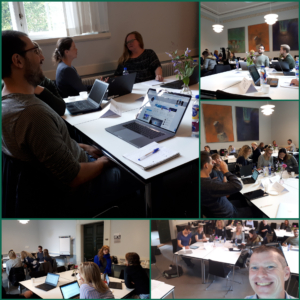
The feedback session is one of the high points of the ‘Boost Your Research Career with Twitter, LinkedIn and alternative social media platforms’ at the University of Copenhagen.
A participant’s issue could be something specific like this:
‘I need 40 more people to sign up for an upcoming conference that I am organizing and need to find an expert to take part in a panel session. What is the best way to go about it?’
Or it could be a general problem like this:
‘I have a fear of sending things out in the open: I want things to be completely correct before I tweet or post.’
I write the issues at the top of a large A1 flipchart sheet of paper. As each group walks around the room, they have 3 minutes to discuss and formulate their response to the issue.
‘I need 40 more people to sign up for an upcoming conference that I am organizing and need to find an expert to take part in a panel session. What is the best way to go about it?’
When I ring a bell, the groups switch places and move on to the next question, where they both relate to the original issue and the first group’s response to it. There are five or six rounds.
The exercise also works at online meetings. Here the large piece of paper is replaced by a shared google doc, where participants (in breakout rooms) simultaneously update their solutions in the same fashion.
The thing is: After many feedback sessions, I came to realize that some of the issues were already solved by previous participants. So I would be doing everyone a favour by re-using others’ previous responses to the same problem. So I started doing this also.
Participants offer technical solutions to specific technical problems, and some of these solutions are too specific to be released. But participants also offer cognitive strategies and ways to keep up motivation. So it is a good thing if their strategies are used for workshop participants going forward.
I am now going to go one step further!
I release here a selected list of feedback problems, with the participants’ solutions in blue. I have anonymised all the responses, as well as the references to specific institutions and events. If relevant I have added my own previous responses (from the time) in red.
THEME: Twitter and LinkedIn for recruitment, events and networking
- How can I use Twitter/Linkedin to support the recruitment of students and research staff?
- I need 40 more people for the forthcoming conference and expert panel session.
- I want to promote my teams participation in a conference at the end of the year. The organisers, however, are slow to publish the material. How can I build up to it, and get the networking benefits?
Selected feedback from participants:
- Make sure that posts and tweets are regular: basically just events and deadlines relating to the group
THEME: Developing a social media culture at an institution
- My section or department does not have a policy or culture of social media – How do I get my colleagues/labmates to tweet?
- I administer an institution’s account, but I lack inspiration and fear looking uninformed
- I need to have a more proactive approach, but corona makes it a bit difficult to engage more vividly with the researchers
- How do I get my colleagues to tweet, and to post more on LinkedIn?
- In my research coordinator role, I lack the scientific knowledge to tweet and assess the value of someone’s tweets to retweet from the institutional account. How can I do it anyway the best I can?
Selected feedback from participants:
- Focus on the Altmetrics tool.
- Reach out to colleagues on how to better reach out to the target groups, and use my account as a good example!
- Tag them in a tweet or post and ask them to retweet or share
- Live tweeting
- Post a tweet or thread about THEIR recent work (papers)
- Inform them of the benefits, connections, ideas, conferences. Invite Mike 🙂 as speaker to a research group meeting to share the advantages from academic visibility to the group. Share this experience in section and group meetings to encourage others.
- Do a rotating account with the other people in the group, so you do not feeling overburdened with the task
- Delegate to researchers
- Tag them / Hold a water cooler talk about how great it is and how many new project/job offers you got.
- Mike: Set up a rotating Twitter takeover for your scientist colleagues. This will get researchers excited, and more followers! As for content native to the institution’s account: Setting up a LinkedIn search string would help you find original content to post on Twitter. Set up Tweetdeck and monitor for keywords
THEME: Creating engaging content
- I am a first year PhD student, and I don’t think I have anything unique to contribute to the scientific community yet – what should I do?
- I am an informatician and I spend my time sitting behind the computer, writing lines of code and making data visualizations – I do not consider my daily job tasks as “sharable”, any thoughts?
Selected feedback from participants:
- Retweet other peoples stuff until you have more of our own – but have a plan for what is relevant to retweet
- Leverage your own colleagues first (get a bubble then break out of it)
- Create a hub of those who are known or important in the field and start from them
- Look at interactions of colleagues and do retweets based on this
- Ask for a simple summary of their work and tweet that!
THEME: Strategies for increasing engagement
- How can my posts on LinkedIn get more attention?
- How can I get more followers?
- I would like a bigger follower group – I need to be better at selecting good and meaningful @ and # to my tweets. And settle on a good topic.
- My tweets for Friday’s lectures are not getting enough traction. How do I get more likes, follows, and people turning up?
- Finding groups and experts in the field of reasearch have proven difficult. Most of the ‘hotshots’ are either inactive or simply without accounts.
Selected feedback from participants:
- 1) Follow people; 2) Comment in groups in LinkedIn; 3) post novel and topical stuff e.g. genetics;)
- Keep up regular flow of posts
- Be selective in the content you put out and who you follow
- Use popular and relevant hashtags. Follow relevant people.
- Retweet a field-relevant tweet and include a critical comment / open a discussion
- Streamline a Twitter list, and then make it public
- Laymanise your content to widen your reach
- Retweet with emojis 😉
- Big time following of others, hopefully they follow back 🙂
- Fill out bio, and have interesting content
- Participate in conferences+ post about it but also the other participants research
- Mike: Remind yourself that the purpose of your activity is not to ‘increase your follower count’, but to meet new people and develop your own thought 🙂
- Mike: Try the Twitter Circles function
THEME: Finding content, and creating a backlog for scheduled social media posts
- How can I identify relevant people to follow and content to tweet?
- How do I find and build up a backlog of content to share, without seeming ‘behind the times’ to others?
- I am an editor of a journal – How do I get automated email every time one of our papers is published online, so I can tweet it?
- Content generated from our own programme is inadequate. How do I create enough content?
- How do I trace (find) stories (content)?
Selected feedback from participants:
- Search for tags, terms that you are interested in
- Use the explore section and search relevant hashtags
- Tweet content from general newspaper (BBC has good popular science segments)
- Find and follow specific (scientific) journals
- Mike: Follow the people who follow the Twitter account of your favourite conference
THEME: Time management and scheduling, a systematic approach to social media use
- I enjoy networking on Twitter, but it consumes a lot of my time. Any tips for developing a schedule, saving time?
- I tried a Twitter thread and it took me maybe 1 hour or more – I am not sure this is sustainable. If I transform this into other things, e.g. a blog post, or other SoMe content, I could reuse this 60min work for more purposes. Now my problem is to find this one hour each week to do it!
- When I have a busy work life – there are no new tweets
- How do I find the time to think about and generate content to tweet or post?
- Tell me how I can better schedule the time to be active on social media!
Selected feedback from participants:
- Select 15 minutes a day at a specific time for active engagement
- Use scheduling on Tweetdeck, f.ex. to streamline stuff
- Use procrastination time, coffee time
- Put it in the calendar
- Mike: Use Twitter lists and bookmarked LinkedIn searches as your ONLY entry point to your social media. Only do it at one set time of every day
THEME: Personal barriers
- Fear of sending things out in the open, wants things to be completely correct before I send them out.
- I am reticent in sharing my thoughts on social media, and in retweeting contents I do not find relevant – Is there still a point?
- I am new to Twitter and am not good at fast and catchy messages – What should I do?
- I have just begun my PhD and still feels to broad to share any research
- I am too nervous to write / link things in public; I overthink my phrasing; don’t respond to people that comment or respond – Any solutions? How to change my behavior?
- My mindset is that most of what I do, is not really going to be of interest to anybody else. What should I do?
- I feel most of the tweets are to promote yourself. As an introvert, it is difficult to post something.
- For me, it is as if nothing is important enough for me to take a minute of time away from my followers attention. Help me not think this!
- I am still learning the new field and I do not feel certified enough being a voice of authority.
- I find it hard to identify what I should post and what content should I write. I start to question myself and after spending too much time to polish the language, I end up not posting anything.
- I don’t have anything unique to contribute to the scientific community yet – What should I do?
Selected feedback from participants:
- Tweet your thing and see who interacts, then change/improve your style accordingly!
- Mindset: Your regular day is no-one else’s regular day. So your thing might be more interesting to the them than you think.
- Take a moment to notice what you like about other tweets. What you do is interesting to at least one other person (you) and definitely to others
- Retweet just to find what you like. You may recognize it in your daily life later on.
- Post picture of lab/fieldwork
- Retweet posts from people you find interesting
- Ask questions
- Whenever you are researching something, you are alraedy an authority
- You have narrow knowledge compared to experienced researchers, but very deep knowledge
- Mike: Using a social media management system to schedule posts, takes the edge off this. Schedule, schedule, schedule! Practice also helps. Try something new! see what happens. You can always delete it! Don’t EVER feel obligated to post or tweet. Only do it when you are in the place for it.
THEME: Challenges of sharing research and data on social media
- It’s hard to create an overview on relevant tweets as it easily drowns . I guess I have to create lists and use # ??
- How to not share unpublished data that you pick up during a talk?
- I don’t really have a network of people to share the key point of my project and I don’t know properly how to use the apps – but I am here for this 🙂
- I want to let other people know what project I am working on and create constructive discussion. But I do not want to give too much the idea of the project away for others to take at this early stage.
Selected feedback from participants:
- You can post about your hypotheses indirectly by asking questions based on the literature you read to make your hypothesis
- Post ideas of methods and fieldwork, challenge these ideas? Broaden your perspective/network, people won’t know exactly what you are doing, and you will get feedback and new ideas
- Find a ‘safe’ straightforward thing (that indirectly says something about your work) like an upcoming event, publiction, fieldworkk/lab situation
- Post a current work/interest and ask a colleague in the same project for suggestions on Twitter/LinkedIn
THEME: Promoting and positioning yourself as a scientist
- I closed down my old account – How can I back the BEST of these followers on Twitter?
Selected feedback from participants:
- Search for old Twitter handle and see who interacted with, and who retweeted it before – same as when celebraties close/delete their accounts
- Mike: If we were into marketing, which we are not, you would list all the accounts that followed you before you closed your previous account, then automate ‘likes’ to their posts, making them aware of your present account (I know an app that can do that!). But don’t do this! Use your new-found freedom with few followers to your advantage, create a highly focussed feed and community.
THEME: Balancing social media as a tool versus a distraction
- How can I avoid Twitter or LinkedIn being a distraction rather than a tool?
- Information overload. On Twitter there is so much information out there. I feel like I cant keep up with the information coming my way.
Selected feedback from participants:
- Give yourself a daily time limit
- Be specific in the times I do Twitter and LinkedIn, like just give 30 min a day on the work schedule.
- Still perceived as a extremely time consuming. Minimize tweeting and posting to a limited timespan could be a strategy of action
- Mike: Use Twitter lists, hashtags, set up a social media management system so you only see interesting tweets and people. Bookmark a series of focussed LinkedIn search strings. Have it as your goal to NEVER look at the native Twitter or LinkedIn newsfeed 🙂 Use lists and search instead. Do SoMe work ONLY at beginning or end of day to avoid getting distracted in the ‘core’ working hours.
There is a more detailed course description of the ‘Boost Your Research Career with Twitter, LinkedIn and alternative social media platforms’ at the University of Copenhagen here.
Below is a short introductory video:

 [This guide was updated in May 2021]
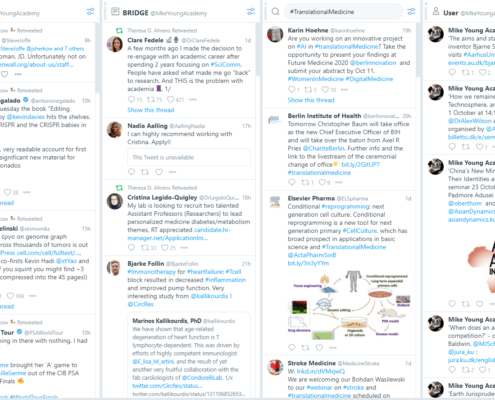

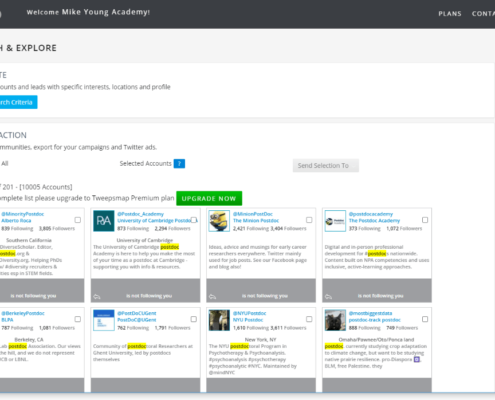 How do you find the right people to follow? There are several add-ons out there that allow you to search for specific terms in people’s bio descriptions. Most are good, but you also have to pay up.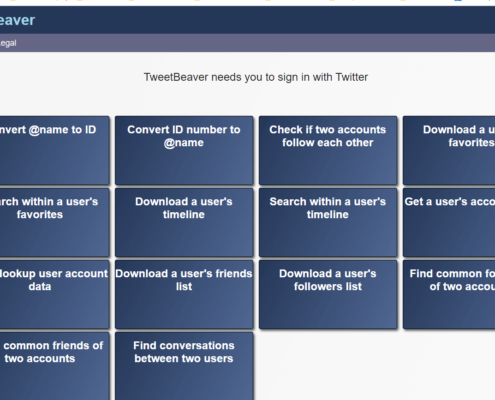



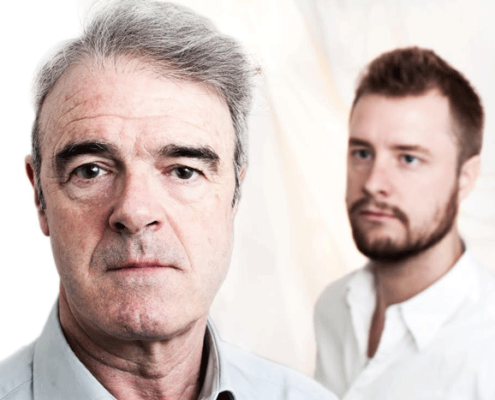





 That is why Mike Young Academy invited Lillian Wilde, a philosopher and visual artist, to analyse the play in this blog post, and to interpret it in the form of a series of visuals based on photos of the actors.
 Twins are natural clones: they are two organisms that evolved from one fertilised egg and carry the identical genetic makeup as each other. Often, we tend to think of them as one entity. But are twins actually identical? PhD candidate at the University of Kent and specialised
  Hoctor grounds his argument on a phenomenological theory of the ‘minimal self’: according to
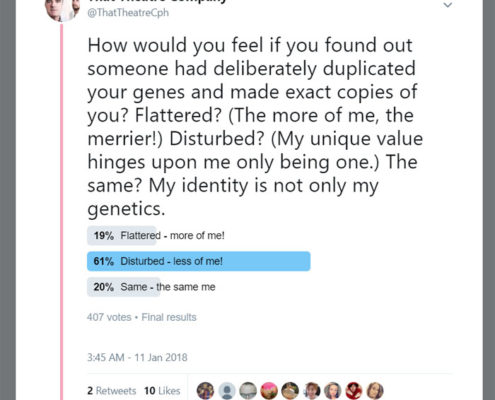
  In the play, the concern is raised about originality . The worry seems to be twofold: Is a copy less ‘real’ than an original? And does the original lose anything, its identity or value, by being copied? If we turn to the art world we see: even the most precise,
  How do we measure how much a person is worth? Economists have come up with one answer:
 This leads me to my last inquiry. How identical are identical clones (or twins, for that matter) really? Is the genetic material the main determining factor of someone’s identity? What role does upbringing, culture, and circumstances play?
  Lillian Wilde (right) is a philosopher and visual artist. All the illustrations for this article are by her.