In the book Social Media for Research Impact we explored the routines researchers used to reach people affected by their work. But do researchers and university communicators see the role of social media in the same way?
When we interviewed researchers for the book, we found that social media, including newer, niche, and field-specific platforms, benefit the practice of research in many surprising ways.
This led us to a series of recommendations, also for university staff and science communicators, that we hope can improve practices: For the sake of the researchers, for the sake of universities, and for the sake of the world.
But after the book came out, I still wanted to know whether researchers’ own understanding of the best use of social media platforms in their professional life is in line with the understanding of professional communication staff at universities.
Both groups, researchers and university communication staff, bring expertise to the table. But they have different goals and perspectives.
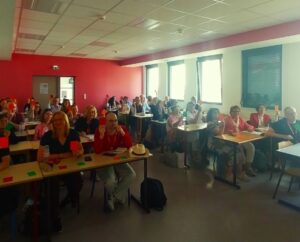
Luckily for me, I got the opportunity to test this last week when I facilitated a workshop at EUPRIO, a conference for Europe’s top university communicators, in Metz, France.
My workshop was called ‘Five surprising ways that researchers make the world a better place via social media – and how university communicators can help them’, and I did it twice in a row for a total of 70-80 communication staff representing a cross-section of European universities, with a couple of universities from South Africa as well.
My method?
I distilled some of the key researcher perspectives from the book and designed a series of what I suspected would be ‘provocative’ statements to the university communicators in the room.
They would respond with green, orange or red cards depending on whether they agreed, were uncertain, or disagreed with the statement.
Then I opened the room for discussions in pairs, small groups, and the whole room.
Thinking, not visibility
Let us start with the first.
From a researcher perspective, social media is about improving the quality of your own research and having a specific impact in the world that is related to your own expertise area. In short, it is about thinking, not visibility. We all know examples of researchers who have and seek celebrity status among the general public. But for most researchers, visibility is a byproduct. At most, they want recognition from a select group of peers and seek a deeper meaning behind their work.
The value of social media, then, is that it allows researchers to think, test, connect, and adapt their work in a public-facing setting.
So here is the provocative statement to university communicators:
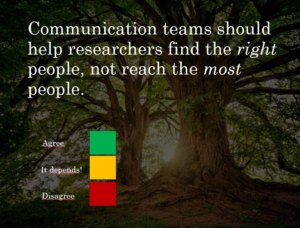 Claim: Communication teams should help researchers find the right people, not reach the most people.
Participants in the room reacted with green (agree), orange (it depends) and red (disagree).
To paraphrase the arguments from participants in the room:
Green: Ultimately yes. As individual university communicators we want researchers to find the right people, not just the most people. And this, even if we as an institution want our researchers to have a wide and large impact. Remember also that researchers themselves often know who the ‘right people’ are better than we do.
Orange: Yes and no. We realize that reaching the most people is fighting for space in a zero-sum attention economy, but that is the reality we face. But sometimes you need visibility before you can find the right people.
Red: No. In practice, trying to reach the most people will in effect lead to the right people, because that is how social platforms work. There is a higher chance of a researcher achieving impact, also at an individual level, if the platforms are allowed to do their algorithmic work, and make connections between otherwise separate individuals.
Let us move on to the second researcher perspective from the book:
Conversations, not numbers
From a researcher perspective, the important thing is not how many people saw a post. It is whether the right conversations happened because of it.
This leads to my next ‘thought-provoking’ claim that I offered the room:
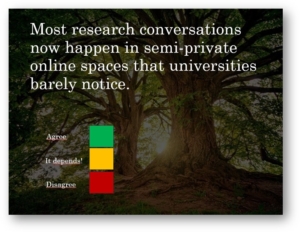 Claim: Most research conversations now happen in semi-private online spaces that universities barely notice.
With semi-private online spaces I mean within platforms that have a community or group function that functions as social media, but with limited access, like LinkedIn Groups or WhatsApp. Ten years ago, more scientific conversations online took place in completely public fora, like on the old scientific Twitter, and this allowed university communicators to tap into, and help the scientific enterprise in real time.
So what did my captive audience of university communicators say? After all, they know their own university’s researchers best.
I got a full traffic light in the room in both sessions, with green, orange and red represented. This is what I heard in the room:
Green: Yes, it is a ‘problem’ if it is a problem! There was indeed a more direct access to researcher working lives via digital platforms ten years ago. It does not help either that universities now have metrics that are easier to observe than conversations.
Orange: For us as communicators this is an unknown unknown! We can only observe the scientists who we follow. And we tend not to follow researchers in the type of internal discussion groups where research ideas, or stakeholder feedback related to that research takes place in general. So we cannot verify this claim!
Red: No, I don’t agree. The researchers I know at our university use legacy platforms that either do not have this functionality, or they do not use it, if they do. Also: Researchers have always had private conversations. This is not new. The platforms have changed, but the phenomenon has not, so I don’t see it.
Let us move on to the third researcher perspective:
Slow impact, not virality
Social media impact in research is often slow, quiet, and cumulative. It often happens on smaller, niche, platforms where virality and numbers don’t count. Or via a simple post or comment on a major platform like LinkedIn, that is hardly noticed by anyone else than the person who is impacted. One quality interaction with one colleague that inspired you is worth the effort.
My provocative claim that I directed at the university communicators would go even further and say that:
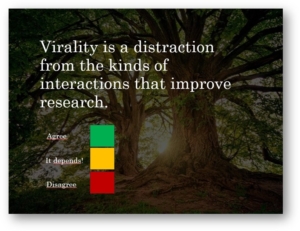 Claim: Virality is a distraction from the kinds of interactions that improve research.
We got the full rainbow with green, orange and red cards being flashed in the room and a lively discussion in both sessions:
Green: Yes. The distraction by virality does happen for both scientists and science communicators. Viral posts, and the hunt for thousands of views can be addictive and detrimental to the science, and it takes focus away from the thinking and the working. It also, in itself, creates pressure to simplify complex research.
Orange: Yes, and no. Science communicators and scientists can try to manage the distraction of virality on platforms as individuals. But a larger problem is the type of behaviour that virality engenders. Virality can affect the type of science that is produced in the first place.
Red: No I don’t agree. Virality of a science-related post can often be a way to bring in groups of stakeholders that otherwise would not come into contact with a particular scientist or scientific finding. Virality can help scientists or scientific findings jump out of the bubble of their existing network. In a wider sense, this is where researchers should not get to choose: Some topics require broad public attention.
Let us move to the fourth researcher perspective:
Growing, not winning
Researchers should use social media to learn, connect, and experiment — not to dominate the attention economy.
A typical LinkedIn newsfeed will be packed with advice from communication experts on how to achieve thousands of views on your posts. But this is a trap. ‘Winning’ looks like attention on a platform like this. But view count has little real impact in the real world.
Not heeding the advice from these ‘experts’, the researchers we interviewed used platforms to meet specific people. They were often there to listen rather than broadcast to many. They wanted to grow as people. And if the platforms did not deliver they went somewhere else. They actively experimented also, above and beyond the kind of activities that the experts advised them to.
I extrapolated it yet again to a fourth outrageous hot take:
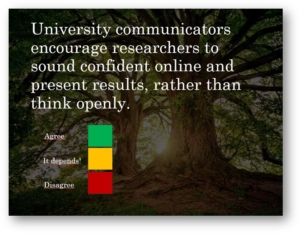 Claim: University communicators encourage researchers to sound confident online and present results, rather than think openly, revealing doubts and uncertainties.
We got green, orange and red in the room. This is what participants said:
Green: Yes, we do. But this is partly because we as university communicators come into contact with researchers at the exact point when their research is finished. This requires confidence, and some of us even do media training to help this along the way. Society also generally rewards certainty rather than curiosity.
Orange: Yes, and no. Some scientists are more oriented towards ‘working out loud’, while others are not. As a university communicator I don’t push a scientist towards not showing the doubts and difficulties. If the problem is there, it is more of a scientific culture thing. Another thing: Researchers who openly share their uncertainty can be misunderstood, especially outside academia.
Red: No. I don’t recognize this. I think that in general, the net effect of our work is the opposite. By getting our scientists out there, discussing with their peers, they are at the same time learning to work out loud interacting with peers at the exact moment when science is produced. Confidence enables them to express doubts about their own work in process.
Finally, let us take on a fifth researcher perspective from our book:
Kindness, not brand
Social media becomes meaningful for researchers when it is oriented toward generosity, usefulness, and supporting a caring scientific community.
Most researchers, throughout the world, use social media to let their research help others. They help their researcher peers, professionals who work in fields related to their science, businesses, patients, and practitioners who could benefit from their work. This is not for their own, or even their university’s, visibility. This is simply to be a force for the good.
In this way, they want social media practices to support the idealized norms of science first formulated by the sociologist Richard Merton: Science should be communal and belong to the scientific community rather than to individual researchers, universal and evaluated according to the same criteria regardless of who makes them, disinterested in the sense that scientists should act for the advancement of knowledge rather than personal prestige, and claims should be subject to organized scepticism, tested before being accepted.
But here is a provocative claim for you.
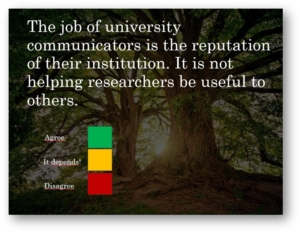 Claim: The job of university communicators is the reputation of their institution. It is not helping researchers be useful to others.
Full traffic light in the room. This is what participants said:
Green: Yes, I agree. It is part of what we are paid to do. Our institutions are also oriented towards science and upholding a scientific community, but our incentives and scientific ideals are not always aligned.
Orange: I don’t understand the conflict between our institution’s reputation and that scientists want to use social media to help others. They can often be exactly the same thing!
Red: No. I disagree completely. As university communicators we are aligned with kind scientific practices. There is nothing to see here: Universities themselves are public-good institutions. Helping society is our mission.
That was it!
The purpose of our workshop was to spell out the arguments from university communicators, and get them to respond to the claims by scientists interviewed in the book.
I think it worked!
I am now sharing this blog post with participants in the room and would welcome their feedback: Did I misread an argument? Am I forgetting one that was not formulated? Should I have been more precise? If you were there and think that I have missed something feel free to let me know by writing to mike@mikeyoungacademy.dk.
Social media for research impact is a new book by Mike Young and Marcel Bogers (January 2026). It invites you to think more clearly — and ethically — about how to use social media. Not just to disseminate your research, but to connect, ideate, co-create, and stay open to the unexpected. The book page is here.
Does your department, faculty or university need to boost its researchers’ international impact? My workshops in social media for scientists and AI for research networking and communication introduce researchers to the systematic use of LinkedIn, Bluesky, Reddit, X and other specialized social media and tracking applications as well as AI-augmented routines to find and reach collaborators and stakeholders. All Mike Young Academy workshops are bespoke and custom-fitted to specific scientific fields. Workshops can be held in-person, or online as a combination of video-conferenced live-sessions with group ‘breakout’ rooms, individual feedback, and homework.