LinkedIn and social media networking — course for health science PhD students

A practical, hands-on workshop in health science networking and communication via LinkedIn and other social media platforms. 

The course will be held in the new Maersk Tower at the Faculty of Health and Medical Sciences, University of Copenhagen. (Image with permission from Instagram user @Dead_Lab

This PhD course at the Faculty of Health and Medical Sciences in Copenhagen is free of charge for PhD students at Danish universities (except CBS) and for PhD students at graduate schools in the other Nordic countries. You can read more about the course and sign up here.

Scientists within the health and medical sector will find LinkedIn (and other social media platforms like Bluesky) particularly useful:

  • The platforms allow real time access to, for example, patients’ and public perspectives, communities of support, and to advocacy groups internationally — but within a narrow medical specialization.
  • The increased use of visual abstracts and digital formats in communicating research has been helped by the LinkedIn and Bluesky/X scientific community.

There are more details below this short introductory video:

The course is at the University of Copenhagen’s Faculty of Health and Medical Sciences and is open to all PhD students at Danish universities (except Copenhagen Business School) and for PhD students at most graduate schools in other Nordic countries.

A typical ‘visual abstract’. A shareable digital format that has taken off in recent years, particularly in the health and medical sciences.

The course goals

You will:

  • Learn how to use LinkedIn and other social media platforms to support your work and career as a researcher
  • Find a social media routine that fits your personality, daily routine and specific medical specialty
  • See how to be strategic in your use of social media
  • Set up personal routines, augmented by automation, for monitoring news and ideas from specific research areas.

Photo with kind permission of Instagram user @nazanins_daily

The course is relevant for both beginners and experienced users.

“Very ‘hands on’. I will definitely recommend this to other PhD students” —  previous participant

Dates: 11 + 25 March 2026, both days from 09:00 to 13:00

There is more information and you sign up for this course here.

Does your department, faculty or university need to boost its researchers’ international impact? My workshops in social media introduce researchers to the systematic use of LinkedIn, Bluesky, Reddit, X and other specialized social media and tracking applications. All Mike Young Academy workshops are bespoke and custom-fitted to specific scientific fields. Workshops can be held in-person, or online as a combination of video-conferenced live-sessions with group ‘breakout’ rooms, individual feedback, and homework.

Researchers are (also) stoking politics on Bluesky. Here is how to avoid it

When researchers migrated from X to Bluesky, the hope was for a quieter space. They wanted less outrage, and more science. But reality is biting back. So here are a few tips to avoid the politics anyway.

Is scientific Bluesky being swamped by US politics?

The posts from influential scientists that are driving ‘engagement’ in the form of likes and reposts on Bluesky is not science. It is political commentary and cultural hot takes – mostly focused on left-of-centre and progressive US politics.

This is according to an analysis of 18,000 posts from influential scientist accounts by my colleague Lasse Hjorth Madsen. He has looked at the highest performing posts in terms of likes and reposts among 200 highly influential science accounts on the platform. Lasse’s post analysis comes after several iterations where he and I (Mike) have jointly mapped out the emerging Bluesky scientific community, finding the most central and influential scientists and research fields on the platform.

Lasse’s latest analysis points to something uncomfortable: Some academics are not just victims of the attention economy, they are active participants in it. And the tone of the posts that spread, mirrors the posts that spread elsewhere online — politics, outrage, frustration, and protest.

The table above shows the most liked original posts (not reposts) among our influential scientists’ group.

Before we go on, I need to both hedge my claims, and try to give an explanation of what is going on:

  • Bluesky, to a much higher degree than other platforms, enables you to set up your newsfeed so that you only see what you are interested in. The most savvy Bluesky users can avoid the politics, and some of them will do so (see my tips below). That is one of the reasons why many scientists are there in the first place.
  • The analysis is based on the top 200 of our ‘most influential’ list, based on centrality measures. This group could be already pre-selected to have centrality because they are already in a non-science politically-oriented community that enables the wider traction. What we see is a kind of circular logic that might not prove anything.
  • When you count reposts of academics’ original posts, all of the reposts are not necessarily coming from academics themselves. On Bluesky, when you repost, it can be shown on your own followers’ feeds. What this means is that a political post from a scientist, could be highly reposted outside the scientific community, then circle back to be seen by other scientists after it has been circling around the political echo chamber gaining likes and reposts from people who want to virtue signal a specific political standpoint.
  • A large part of scientific Bluesky is scientists from the United States, so it is, actually, no surprise that posts about US politics dominate global feeds.
  • Scientists are, in fact, generally mostly left of centre in terms of their politics.
  • Scientists on Bluesky are, to a higher degree, left of centre in terms of politics, precisely because a large group of them have migrated from X after the controversy surrounding the Elon Musk takeover.
  • The group of scientists who get the most likes and reposts is likely hiding a much larger undergrowth of scientists on Bluesky who avoid politics, and are happy to avoid viral hot takes.

We have to be really careful we are not mistaking correlation for causation here. Our analysis does not show that posting political hot takes lead to more reposts or higher follower numbers. Heaven forbid, this will not lead to more understanding and more impact for science. Our analysis just shows that highly central scientists in our group got the most reposts when they did post politically.

The lesson? A new platform doesn’t erase the old dynamics. If researchers want Bluesky to become more than an alternative outrage machine, they will need to make some conscious choices.

What can you do to avoid politics?

So how can we help this along? What do you do if you want to avoid politics in a professional or academic context altogether?

As a first step use the functionality of Bluesky to set up different feeds for different topics and modes of working. If you really want to see the politics, then leave the standard newsfeed that lets you see ‘Following’ (you can see my feed on the image above – the feed that is headed ‘Following’). Otherwise set your front page so that you don’t see following as the first thing.

Now set up feeds with only your interests and lists, and make sure that they show first on your newsfeed.

Feeds can be found on the left

See the hashtag symbol on the left? Click on that.

Lists, like good old X, are sets of people that you want to see the posts from. You can find those by clicking on the little bullets symbol below the hashtag. In my set-up shown above right my list of ‘Danish research institutions’ is showing on number fourth spot. Lists on Bluesky are always public.

There is a good guide on how to customize bluesky feeds here.

Click on the cogwheel

But what you need to know is that you can adjust the front page of your Bluesky, so that the first thing you see on the app or on desktop, is a specific feed with your interest. You don’t have to see the posts from the people you are following before you see your interests. This is a great way to avoid getting ensnared in the politics and hot takes.

As a second step, if this does not work, and this goes for Bluesky just as much as any other social platform: Just unfollow the people who post about the politics. Tough, but they had it coming for them. They won’t get a notification.

Click the arrows to adjust which feeds should show first when you open Bluesky. Adjustments apply to both your desktop and phone versions.

As a third step, you can hide a specific account if you see a political post anyway in spite of your unfollow (someone in your network who follows them might have reposted it, which will then put it on your feed). Just click on the three dots at the bottom of the post to mute this particular person. This is also the place where you can block particular people which stops them from interacting with you.

Fourth step. Bluesky’s starter packs feature lets you follow groups of scientists within your own field. This is brilliant. But be aware that large starter packs may include a number of scientists who post about politics. So a fourth step is to unfollow or mute these specific offending scientists afterwards (back to second step!)

Bookmarked searches are the final resort if you can’t get the feeds to shed out all the politics

Fifth step. Sometimes all of the above is not enough to maintain a non-distracting, non-outrage, non US-politics focussed feed anyway. For many specific tasks I resort to bookmarked keyword searches. Just as an example, this link only shows the Bluesky posts that have the ‘University of Copenhagen’ in them.

I hope this helped!

Do you have any further ideas on how to avoid politics on Bluesky? Let me know in the comments!

Social media for research impact is a new book by Mike Young and Marcel Bogers (forthcoming). It invites you to think more clearly — and ethically — about how to use social media. Not just to disseminate your research, but to connect, ideate, co-create, and stay open to the unexpected. The book page is here.

Bluesky is emerging as the new platform for science

Scientific Twitter is about to find its true successor. And it is not X. This, our latest release, shows that the Bluesky network of scientists is growing — and growing.

The network of scientists on Bluesky has evolved significantly since our last update, now including 39,030 influential people in the scientific community, a 75 per cent increase over the 22,225 that my good colleague Lasse Hjorth Madsen and I released three months ago.

The total number of academics, researchers and science communicators on Bluesky will actually be much much larger, but this number: 39,030 is is a good estimate of the number of scientists who have a substantial scientist following within the scientific community itself. You can see how influential scientists make it on to our list here.

Lasse Hjorth Madsen (left) and I (right) are still enthusiastic about generating this model of the global scientific network

The growth that we see signals not only a broadening interest among scientists and science communicators for the platform. It also illustrates an increase in interconnections within the community.

No surprises here!

When you as a scientist move to  a new professional social platform, you start to follow people. And it is likely the increase in these followings that also pushes the scientist numbers upwards in our model.

Mapping the big migration

With this update, we’ve incorporated timestamped data showing when each profile joined Bluesky, offering new insights into how scientists migrate across platforms.

Our top 100 list on Bluesky showcases a diverse range of scientists and science communicators on the platform who are particularly influential

A significant increase in sign-ups took place in August 2024, which may correlate with the wave of negative publicity surrounding the owner Elon Musk and the ban of X (formerly Twitter) in Brazil.

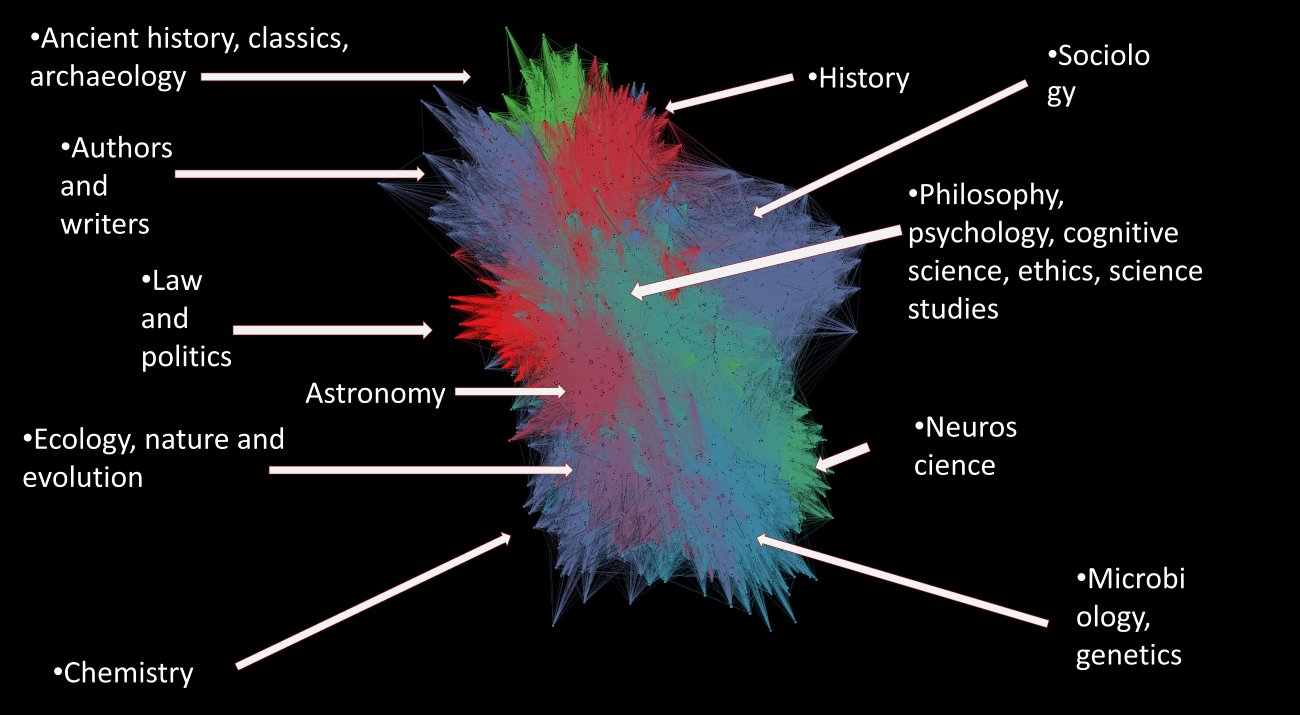
I have labelled some of the communities on this screenshot of the visualization here. Boundaries between research fields are decided by the algorithm. Some fields will be included in other communities.

More recently, the controversy over Elon Musk’s support of Trump in the US election has set off another wave of  migration away from X.

Based on your feedback, we’ve revised our keyword set, expanding it to better capture diverse scientific fields. All scientific disciplines were also represented in the network’s structure in previous releases, but now we are even more certain.

Community boundaries between research fields are decided by the algorithm, and not by us. This means that important fields will in practice be included in other communities.

Within the network, different communities naturally form around certain interests. These clusters are algorithmically determined, and then labeled. However, these labels serve purely as a reflection of network structure and not as judgments on a field’s importance or size.

Just like on other social platforms, Bluesky has a skewed distribution of followers: A few individuals maintain sizable audiences, while most of us have smaller ones.

If a specific area of science isn’t labeled explicitly in our rendering, then it is likely because it is already well-integrated into a related community cluster.

New top 100 scientist influencers

Our top 100 list on Bluesky showcases a diverse range of scientists and science communicators on the platform who are particularly influential in terms of a measure called centrality. More on that here.

As for follower numbers. Just like on other social platforms, Bluesky has a skewed distribution of followers: A few individuals maintain sizable audiences, while most of us have smaller ones.

We meet up regularly in Copenhagen to square off the network analysis details

Since our last iteration, we have seen notable growth in a community labelled as ‘law, science and policy’. This suggests that interest in social science issues may be particularly resonant on Bluesky.

You can get an overview of our methods here.

Our method follows on from my own former TwiLi Index of recent years, which was an alternative measure of scientists’ ‘impact’, based on Twitter (now X) and LinkedIn following numbers.

New network visualization

Click and have a look at Lasse’s interactive visualization here.

We build our Bluesky network by doing this: We start off with a list of hand-picked members of the scientific community. Then we expand the network step-by-step, finding the scientists on Bluesky that they follow, and subtracting those that are not followed by a substantial number from the existing network.

We then use a key term search to subtract those that do not have a bio description that indicates an affiliation with the scientific community. Then we repeat the process again and again, until we are no longer getting substantial numbers of new scientists.

We compute centrality measures like ‘betweenness centrality’ and ‘PageRank’ to identify members that may be particularly influential.

Explore the network

We encourage you to play around with our network visualization tool, where each node represents an account and where the lines between them illustrate followings. The colours of the network are the distinct research communities which have a higher number of interconnections.

One final thing.

Our project aims to foster scientific collaboration and community, and is driven by the simple belief in the value of more meaningful connections.

We welcome your input as we refine our tools, and appreciate any comments or thoughts!

Does your department, faculty or university need to boost the international impact and career of your researchers? Here is more about my courses in social media for researchers. See other Mike Young Academy services here.

Communities of scientists are emerging on Bluesky

Global network data: The ‘nicer’ alternative to X is fortifying its presence in fields that range from philosophy to chemistry, finance, and beyond.

We have extracted a new network of scientists and researchers, and a new global list of 100 science ‘influencers’ on the social media platform Bluesky.

And our numbers show that the community among scientists is getting stronger.

When my good colleague Lasse Hjorth Madsen and I extracted the Bluesky numbers in February, we found 8,900 influential scientists on the platform that were followed by at least 30 other scientists in the same network.

Distinct scientific communities can be clearly identified in the interactive visualization

Now there are 22,225 scientists that follow our definition – a 150 per cent increase.

The uptick in numbers could be either from an increase in Bluesky scientist numbers; from an increase in the number of scientists following other scientists there; or from both of these factors.

Network advantage

As a whole, Bluesky has shown only slow growth since February, with bursts of new users coming to the platform every time there is a new scandal by the owner of its larger competitor X (the former Twitter). It has 6 million users as of July 2024, a minute fraction compared to platforms like X and LinkedIn.

Scientists predominantly use X and LinkedIn for professional scientific networking, but with Bluesky and Mastodon in recent years hoping to break through as alternatives.

The fact that they are a small distinct community allows scientists to surveil and monitor their field, with less likelihood of their feeds being swamped by irrelevant posts

New social media platforms generally have a hard time competing against already consolidated incumbents.

The received wisdom is that older platforms like LinkedIn and X already have the user numbers and engagement. Users that join a newer platform therefore experience fewer meaningful conversations and activity, as there is less chance to meet people there initially that are closer to them socially, geographically, and in terms of common interest.

One community at a time

However, my claim is that it might not exactly work like that in the world of science.

Lasse and I have been working on mapping out researchers’ social media communities for several years now.

Scientists can gain an advantage from forming tight-knit communities of like-minded colleagues in specific fields. The fact that they are a small distinct community allows scientists to surveil and monitor their field, with less likelihood of their feeds being swamped by irrelevant posts.

And they are more likely to take the step to a smaller platform so long as a smaller community within their field already exists there.

To use a metaphor, scientists are like particles of dust at the beginning of our Solar System. As they ‘collide’ (or are introduced by colleagues to a new social platform within their field) they gradually form larger bodies like planets. These ‘planets’ are the communities that we now see.

This might be what is happening on Bluesky.

Our extraction of data shows a series of distinct communities. Within each of these communities the users tend to follow each other:

  • Philosophy, psychology, cognitive science, ethics, science studies
  • Authors and writers
  • Ancient history, classics, archaeology
  • Microbiology, genetics
  • History
  • Law and justice
  • Ecology, nature and evolution
  • Linguistics
  • Military history
  • Left wing and progressive politics
  • Geoscience and palaeontology
  • Chemistry
  • Music theory
  • Economy and Finance
  • Plant biology

Top 100 scientist influencers

Our new global list of 100 science ‘influencers’ on Bluesky is here.

It uses a crafty method to find the most influential scientists, and you can get an overview here.

The method follows on from my annual TwiLi Index of recent years, which was an alternative measure of scientists’ ‘impact’, based on X and LinkedIn following numbers.

Click and have a look on Lasse’s interactive visualization here.

We have built our Bluesky networks by using an iterative algorithm that works like this: We start off with a list of hand-picked members of the scientific community. Then we expand the network step-by-step, finding the scientists on Bluesky that they follow, and subtracting those that are not followed by a substantial number from the existing network.

We then use a key term search to subtract those that do not have a bio description that indicates an affiliation with the scientific community. Then we repeat the process again and again, until we were not getting substantial numbers of new members.

As the recent breakup of the scientific social media exchange space has shown recently, an equilibrium where individual scientific fields ‘congeal’ together on different platforms is also possible.

The result? A science-oriented network of now 22,236 scientists on Bluesky. Most work in academia in research institutions. A few of them are science writers, independent researchers, or work at private organisations.

We compute centrality measures like ‘betweenness centrality’ and ‘PageRank’ to identify members that may be particularly influential.

Scientists could coalesce — or dissolve into fragments

What is going to happen from now on in terms of social media in science?

There are many potential pathways. There is a huge advantage for science if there is only one or two large platforms where all scientific exchange takes place, so long as scientists can use the platforms to monitor their fields without getting distracted. But as the recent breakup of the scientific social media exchange space has shown recently, an equilibrium where individual scientific fields ‘congeal’ together on different platforms is also possible.

I appreciate any comments or thoughts!

Does your department, faculty or university need to boost the international impact and career of your researchers? Here is more about my courses in social media for researchers. See other Mike Young Academy services here.

A global network of scientists on Bluesky Social

We have worked out a network of scientists and researchers on the new social media platform Bluesky Social! And a new global list of 100 science ‘influencers’ on the new microblogging alternative for those who are tired of X.

Some call it the new scientific Twitter. And Bluesky Social does indeed look, and feel like, the good old Twitter a few years ago before it turned into X with all its problems and controversy.

According to CEO of Bluesky Social Jay Graber, their new logo ‘symbolizes … the Twitter bird freed from a closed platform to fly in Bluesky’s open ecosystem.’

And the cool thing is, my good friend Lasse Hjorth Madsen and I have used a nifty method to find some of the most influential scientists on the new platform. Get an overview here.

The method follows on from my annual TwiLi Index of recent years, which was a cheeky alternative measure of scientists’ ‘impact’ for the Nordic region, based on Twitter (X) and LinkedIn following numbers.

The idea is to better understand how scientists shape networks with each other, and build communities of interest on the platform. And on scientific BlueSky, as can be seen on the interactive graph here. you can so far see several large lumps of research specialties:

Political Science

Psychology, neurology

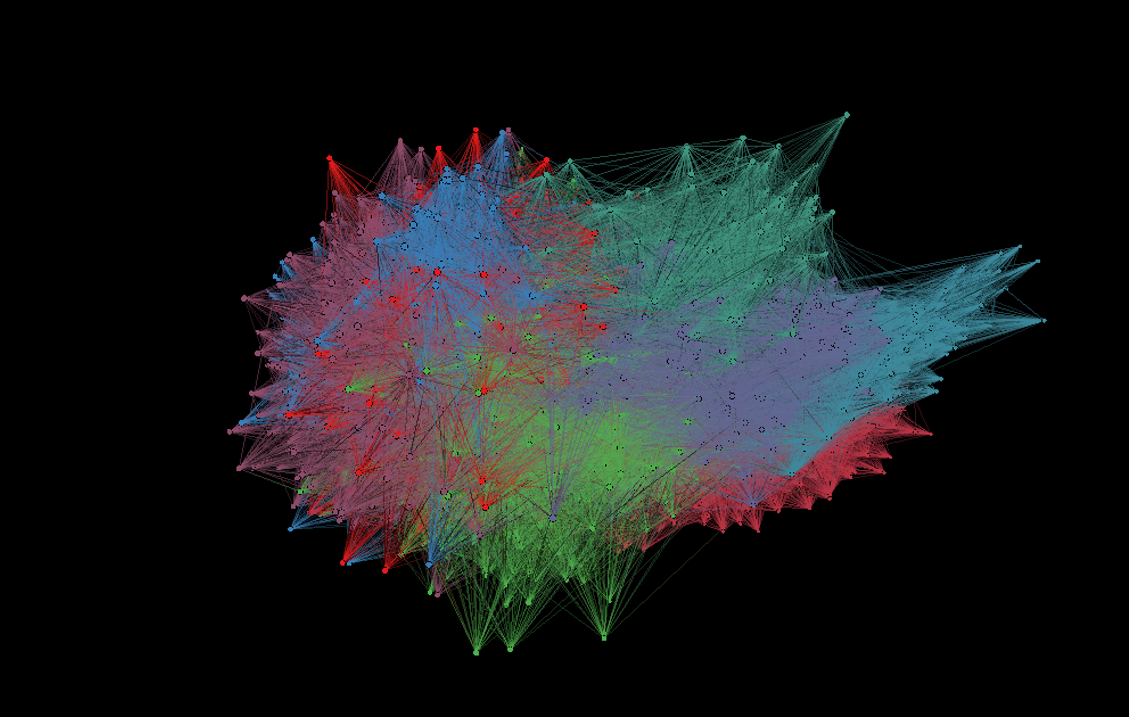
There is the political science community (left, bright red), psychology, neurology and cognitive science (right, pink), social policy and economics community (pea green), biology (bluish purple), microbiology and genes (light blue), history (reddish purple), law (another bluish blue) that somehow cuts through the history community.

Biology

Social Policy

Click and have a look on the interactive visualization. Can you find any more communities?

We built the network using an iterative algorithm that works like this: We

Microbiology and genes

started off with a list of hand-picked members of the scientific community,

History

then we expanded the network step-by-step, finding the scientists on Bluesky that they followed, and subtracting those that were not followed by a substantial number from the existing network.

Law

We then used a key term search to subtract those that did not have a bio description that indicated an affiliation with the scientific community. Then we did the process again and again, until we were not getting substantial numbers of new members.

The result? A science-oriented network of 8,949 scientists on Bluesky. Many, but not all, do research at a research institution. A few are science writers, independent researchers, or work at private organisations.

With this network established, we then computed centrality measures, like Betweenness centrality or PageRank to identify members that may be particularly influential.

Our network of Bluesky scientists looks like an alien spaceship in a dark universe.

Over at the list of Influential Scientists, we have a table with the top-100 members of the network, ranked by centrality. Feel free to explore the list, or play with the interactive Network Visualisation of course. See if you can find yourself!

By the way: Bluesky Social, just like Mastodon, is an alternative to X (former Twitter). And one that for a newcomer is very easy to get a hang of.

But in direct competition X is still massively holding its own in terms of engagement as of February 2024. And the migration away from X is more a migration to a different type of platform like LinkedIn, rather than a migration to its microblogging competitors.

This was from when we were working on the TwiLi index two years ago. But we are just as handsome now!

My prediction? I think the old scientific Twitter has seen a ‘research field community migration’, where some fields have seen big migrations away from X, while others have stayed. And research communities tend to migrate together, as the large presence of political scientists on Bluesky bears witness to.

X could still make a comeback in science! Some of the new features on X work well with the scientific community. The circles function allows you to post to a smaller group of your own followers, and the ‘X spaces’ live talk feature is good for talks and debate.

Only time will tell.

I appreciate any comments or thoughts!

Does your department, faculty or university need to boost the international impact and career of your researchers? Here is more about my courses in social media for researchers. See other Mike Young Academy services here.