The TwiLi Index – a new method to count scientists’ social media following

Simply adding up followers doesn’t make sense. This new method is better, I reckon, and can be used as a proxy to assess scientists’ relative social media impact.

[This post was updated in September 2022]

I wanted to do this for an awful long time: Find a method that could compare follower numbers on the social media platforms that are the most used by scientists and researchers, namely Twitter and LinkedIn.

Living and working with science communication in the Copenhagen area, I wanted also to use the Danish metropolis as a first test case to find out which researchers and scientists would get on, say, a top 100 ranking.

What I cooked up, I hereby (drum roll!) name the ‘TwiLi Index’ (pronounced like ‘Twilight’ without the ‘t’) . Its first application was seen in 2019, where I ranked the top 50 scientists and researchers in the Greater Copenhagen / Øresund region.

The latest (2022) rank of scientists in Denmark can be found here.

Previous TwiLi Index ranking releases:

The problem

For good or for worse, scientists and researchers are assessed and evaluated by their ‘impact’. Most often, it is the number of scholarly citations that is considered the most important measure of this. Google Scholar, f.ex., shows researchers and scientists h-index, which is based on the scientist’s most cited papers and the number of citations in other scholarly work.

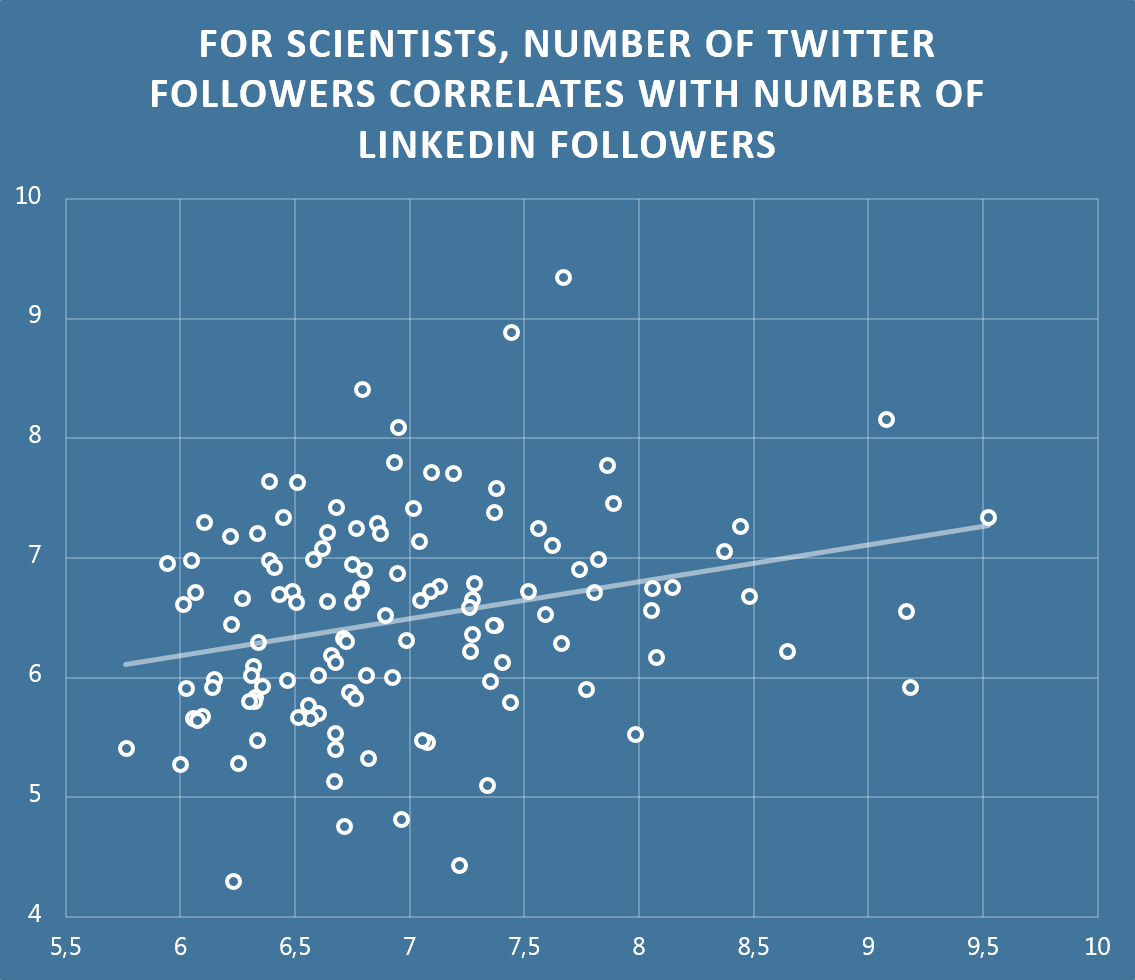
Each scientist is represented by a dot. On the x-axis is the log of their number of Twitter followers. On the y-axis is the log of their number of LinkedIn followers

At the same time, many scientists have embraced the use of social media to disseminate their research, and to network with other scientists. They are often supported in this by their affiliated university institutions that can improve their brand among stakeholders, other scientists, and the wider public if their own scientists are active on social media.

In all spheres of life nowadays, the number of social media followers correlates with real, or certainly perceived, status. Academia is no exception, and follower numbers seem to correlate well with other measures of success.

The TwiLi Index is, I feel, a better, more honest, way to calculate the numbers.

The number of social media followers is visible, and important. If for nothing else then certainly as a ‘vanity metric’ that supports researchers and their institutions’ egos.

A well-known metric that calculates social media impact for researchers is the so-called Kardashian Index (K-Index), named after the pop star Kim Kardashian. It is a measure of the discrepancy between a scientist’s social media profile and their publication record. The measure compares the number of followers a researcher has on Twitter to the number of citations they have for their peer-reviewed work.

The trouble with the Kardasian index, which was invented by Neil Hall, is that the index itself is a criticism of scientists having to have a social media impact at all.

To slightly misquote the Good Book, ‘for every one who has followers, more will be given…’

The TwiLi Index is, I feel, a better, more honest, way to calculate the numbers. A high social media following for a scientist is, everything being equal, surely a good thing. But apart from that, I take no stand on the deeper issue of whether activity on social media, or (heaven forbid!) competition over social media impact is a good thing for science in general.

The method

You could just count followers.

But the trouble with just counting followers is that social media platform followings are susceptible to a runaway, Matthew, effect. To slightly misquote the Good Book, ‘for every one who has followers, more will be given…’ People are more likely to follow the accounts that already have many followers. And this effect is exacerbated by the effect of accumulation over time, so that the longer an account holder is active on an account, the higher the likelihood that he or she has many followers. This favours long-serving, distinguished researchers who have been at it a long time, and who are more likely to have a successful academic career behind them: Succesful professors who have many followers, tend to have many, many followers.

So if we are to compare social media following in any meaningful way, we need to reduce this effect. So my first intervention is to use a base 10 logarithm of the follower number to counteract it.

At the same time, the number of followers on one platform, say Twitter, correlates quite well with the number of platforms on another platform, say LinkedIn (see graph above).

As far as I can see, there are three reasons for this.

First and most important. If you have many followers on one platform, you likely already have the status and leverage that attracts followers on another.

Second, if you are very active/successful on Twitter, you are also likely quite active/successful on LinkedIn and vice versa, as you are predisposed to social media activity.

I think it works pretty well. Runaway numbers on one platform don’t give you an unfair advantage. And your index is higher if you have good numbers on both platforms, rather than low numbers on one and excellent numbers on the other.

Third, the posts and information that is accessed on one platform can be leveraged with success on the other, making your other platform more popular.

From this I deduce that just adding the base 10 log of Twitter followers to the base 10 log of LinkedIn followers does not capture this affect. That is why I propose multiplying the two numbers.

Finally I add 2 to each follower number. This is so that if you have zero followers, or only one follower, on one of the platforms, you can still get a meaningful TwiLi number.

The resulting formula is the following.

TwiLi Index number = log (2 + A) x log (2 + B)

Where A = number of Twitter followers and B = number of LinkedIn followers.

I think it works pretty well: Runaway numbers on one platform don’t give you an unfair advantage. Your index is higher if you have good numbers on both platforms, rather than low numbers on one and excellent numbers on the other. And the TwiLi Index ranks researchers in a different way than simply adding or even multiplying follower numbers.

Gathering the data

So how did I proceed in this, my first, tentative, case?

First off, and the most difficult part of it, is to try and find all the scientists in Denmark that have large follower numbers.

Luckily my own @MkeYoungAcademy Twitter account, which I have been running for several years and which tweets about seminars and lectures in the Nordic region, consistently follows and is followed by scientists and researchers in that region. So I used the group I was following as a starting set of data that I could augment as I went along.

I got some help at this point from my good friend and data scientist Lasse Hjort Madsen who helped me to extract good data from my Twitter account to a workable spreadsheet.

Since then, whenever I stumbled across a Twitter account that identified itself as a scientist in the region, I simply added them to the spreadsheet.

I ended up with a macro list with a set of upwards of 3,000 researchers. My daughter Atlanta Young, a historian by training and yet another data ‘ninja’ helped me at this point. She spent some time working up a reasonably fast routine to cross-check the researchers’ LinkedIn follower numbers.

Note here that we looked for LinkedIn followers, and not connections. Connections are, by default, followers. But not every follower is a connection. For most people the two numbers are nearly the same. However for top scientists, the follower numbers can be higher. The follower metric is more comparable to Twitter.

I am also hoping that scientists and researchers who are interested in this ranking – and this goes both for those who make up the top, and those who didn’t make it this time round – will give me feedback on my methodology.

Some scientists were excluded from the list at this point, if they failed to live up to our inclusion criteria (see box above).

Now it was time to apply the formula to the data, and to extract the index. Here I was helped by Andreas Junge. He is a maths whiz who is the CEO of Methodica Ventures when he is not helping his friends with their pet data projects.

The result: The new Twi Li Index, which had its first iteration as a top 50 scientists and researchers in the Greater Copenhagen / Øresund region.

Other metrics of engagement and influence

The social media impact of a scientist cannot, of course, be measured by just putting follower numbers through a formula. There are other, more subtle, measures of social media influence, and my ambition was to find ones that would function in scientist networks.

I have had many a discussion with data scientist Lasse Hjorth Madsen about this, and we came up with two workable measures that we applied in 2021, namely ‘centrality’ and ‘pagerank’.  For this, Lasse developed a bespoke web app for Mike Young Academy to organise a set of publicly available data that was extracted using the Twitter API.

My dataset now consists of more than 3,000 scientists and researchers, but new scientists are being added all the time.

I decided not to integrate Twitter centrality and Twitter pagerank directly into the scientists’ TwiLi score, but list it separately for each of the scientists that made the top 100. I want to keep the TwiLi score separate so scientists can compare their own score with previous years. Also, the beauty of TwiLi is that everyone can check out their own score, just by plotting in their own numbers.  This is not the case with centrality and pagerank, which is a far more data-intensive calculation.

Centrality

Centrality — or technically ‘betweenness centrality’ — sees scientists as hubs for flows of information on Twitter. A scientist has centrality on Twitter if they are shortest pathway between two other people on the Twitter network of scientists.  Say Jill follows me, and I follow Jack. If Jill and Jack don’t follow each other directly, then I am the shortest pathway between them.  You score high on centrality if you are the shortest path between others many times. Centrality in this case has been calculated based on a network of more than 3,000 scientists on Twitter in Denmark. So if you are a scientist with a network that is mostly abroad, you may score lower on centrality in Denmark.

Pagerank

Pagerank, a measure inspired by Google’s original namesake algorithm to rank websites on google searches, sees scientists as attractors of influential followers. It is an indirect, proxy measure of scientists’ impact based on their followers’ follower numbers on Twitter. A scientist has a high Twitter-pagerank if  if the people who follow them have many followers. So getting followed by another scientist who has a high following on Twitter improves your own pagerank. However, getting followed by media and journalist Twitter accounts with many followers will also increase your pagerank. This means that pagerank may favour scientists well-known for other things like politics, business, sport or in fields that are in the public eye.

What now?

My dataset now consists of more than 4,500 scientists and researchers, but new scientists are being added all the time.

My hope is that each summer, I will be able to redo the ranking based on the same methodology. Hopefully with more comprehensive and accurate datasets, and in new geographical areas.

I am also hoping that scientists and researchers who are interested in this ranking – and this goes both for those who make up the top, and those who didn’t make it this time round – will give me feedback on my methodology.

I appreciate any help! Feel free to leave any feedback in the comments below. Or write to me on mike@mikeyoungacademy.dk if you know someone who needs to be on a ranking who I have missed.

My sincere thanks and appreciation go to Lasse Hjorth Madsen, Atlanta Young and Andreas Junge for feedback and help with this project!

Does your department, faculty or university need to boost the international impact and career of your researchers? Here is more about my courses in social media for researchers. See other Mike Young Academy services here.

Copenhagen scientists – the top 50 on social media in 2019

Who are the most popular scientists in the Greater Copenhagen area?

If you define popularity as ‘social media following’ then the 50 scientists on this new ranking might give you a good idea.

I am proud to present a new Mike Young Academy ranking, using a new methodology. This first iteration focusses on active scientists and researchers in the Greater Copenhagen / Øresund region.

Many scientists embrace the use of social media to disseminate their research, and to network with other scientists. They argue that the platforms extend their reach, let them discuss research with international peers, and serve as a catalyst for inspiration. Scientists and researchers are often supported in this by their affiliated university institutions, that strive to improve their own brand among stakeholders, other scientists and institutions, and the wider public.

Social media platforms like Twitter and LinkedIn are ideal for researchers and scientists, as they make it easy to network with niche audiences in highly specialized fields throughout the world.

This new ranking is calculated from the number of Twitter followers and LinkedIn followers (note, not connections, but followers) and the plan is to update it once a year.

If you scroll down, this article gives you an overview of who you should follow if you want to follow the Copenhagen scientists that everyone else … apparently … is following!

I have written about the methodology of my new ranking, that I have christened the ‘TwiLi Index’ pronounced like ‘twilight’ without a ‘t’, here.

this … gives you an overview of who you should follow if you want to follow the scientists that everyone else … apparently … is following!

Are you not on the list?

This is the first time I try to map out the social media field of scientists and researchers in Copenhagen. It is based on part-manually extracted data (see methodology here) and I may have missed some active scientists and researchers who have large followings. If you know someone who should be on this list, (maybe you!), please write below in the comments, or write to mike@mikeyoungacademy.dk.

My sincere thanks and appreciation go to Lasse Hjorth Madsen, Atlanta Young and Andreas Junge for feedback and help with this project!

The 2019 TwiLi Index (updated)

So here it is. This year’s top 50 Copenhagen scientists on social media as ranked on my TwiLi index! (Latest data collected 31 August – 1 September 2019 – more about the methodology here)

1 – Marcel Bogers – UCPH

Full Professor @ku_ifro @science_ku @uni_copenhagen & Research Fellow @GarwoodCenter @BerkeleyHaas @UCBerkeley — PhD:@EPFL MSc:@TUeindhoven — RT≠endorsement

Tw. followers: 8880, LI followers: 3526, TwiLi index: 14.01

Follow Marcel Boger’s Twitter account here:

2 – Alireza Dolatshahi – DTU

Asst. Prof DTU Nanotech (Denmark), TEDMED2015 Scholar #StemCellBioengineering#FlexibleMaterials#MobileDisplays#TissueEngineering#Biomaterials#Nanomaterials# 

Tw. followers: 2168, LI followers: 11954, TwiLi index: 13.60

Follow Alireza Dolatshahi’s Twitter account here:

3 – Kristian Thorborg – UCPH

Sportsphysiotherapist, Ass. Professor, Ph.D. Special interest in hip, groin, hamstring and knee injuries. HAGOS developer. @IntFSPT Vice President

Tw. followers: 13900, LI followers: 1567, TwiLi index: 13.24

Follow Kristian Thorborg’s Twitter account here:

4 – Henning Langberg – UCPH

Sundhedsdata – professor (link: http://dr.med) dr.med  KU 🎓og CEO Data Redder Liv CHC💡data, sundhed og kunstig intelligens ☎️ foredrag 26127913 MBA, CBS Excecutive bestyrelsesudd

Tw. followers: 1730, LI followers: 7290, TwiLi index: 12.51

Follow Henning Langberg’s Twitter account here:

5 – Rebecca Adler-Nissen- UCPH

Professor of Political Science. International relations in theory and practice, EU, diplomacy, digital technologies, social media and everything in between…,

Tw. followers: 4854, LI followers: 1441, TwiLi index: 11.65

Follow Rebecca Adler-Nissen’s Twitter account here:

6 – David Budtz Pedersen – AAU

Professor of Impact Studies | Head of Research | Velux Foundation’s Humanomics Research Centre | Aalborg University. Tweets about #scipolicy #impact #SSH

Tw. followers: 2699, LI followers: 2416, TwiLi index: 11.61

Follow David Budtz Pedersen’s Twitter account here:

7 – Sune Auken – UCPH

Ally, cheerleader, content accumulator, supporting cast member. Tweets on #genre and stuff. @Grundtvig scholar; pastor’s wife and father of four. #ClimateChange

Tw. followers: 11100, LI followers: 724, TwiLi index: 11.57

Follow Sune Auken’s Twitter account here:

8 – Hakim Abdi – UCPH

Postdoc in remote sensing. Researching carbon cycle, image classification, landscape ecology, climate & drought impacts | Part-time Birder | Full-time Dad

Tw. followers: 4547, LI followers: 1174, TwiLi index: 11.23

Follow Hakim Abdi’s Twitter account here:

9 – M.V. Rasmussen – UCPH

Tweets about a world in the making – in English as well as på dansk. Teaches strategy and security at University of Copenhagen. RTs not endorsements.

Tw. followers: 2782, LI followers: 1740, TwiLi index: 11.16

Follow M.V. Rasmussen’s Twitter account here:

10 – Ravinder Kaur – UCPH

Histories of Global Transformations in the 20-21st C

Tw. followers: 934, LI followers: 4498, TwiLi index: 10.85

Follow Ravinder Kaur’s Twitter account here:

11- Akos T. Kovacs – DTU

Professor at DTU Bioengineering – Bacterial Biofilms, Laboratory Evolution, Sociomicrobiology, Bacteria-Fungi interaction; Senior Editor of ‘Biofilms’ (gold OA)

Tw. followers: 5391, LI followers: 806 , TwiLi index: 10.85

Follow Akos T. Kovacs’ Twitter account here:

12 – Mikkel Flyverbom – CBS

Professor mso, Director of Digital Transformations Platform & BSc in Digital Management at Copenhagen Business School

Tw. followers: 1103, LI followers: 3330, TwiLi index: 10.72

Follow Mikkel Flyverbom’s Twitter account here:

13 – Carlos Henríquez O. – UCPH

Ph.D, Section of Molecular Physiology- NEXS, University of Copenhagen #ExerciseMetabolism #InsulinAction #RedoxSignaling

Tw. followers: 1603, LI followers: 1984, TwiLi index: 10.57

Follow Carlos Henriquez Olguin’s Twitter account here:

14 – Katherine Richardson – UCPH

Prof. in Biol. Oceanography, Leader Sustainability Science Centre, Univ. Copenhagen

Tw. followers: 1313, LI followers: 2307, TwiLi index: 10.49

Follow Katherine Richardson’s Twitter account here:

15 – Cristina Legido-Quigley – Steno

Scientist. Head of Systems Medicine @StenoDiabetes  A/Prof @KingsCollegeLon #Metabolomics #Lipidomics Chemistry in #Brain
& #Liver 4 Healthy Aging #WomeninSTEM

Tw. followers: 2111 , LI followers: 1422, TwiLi index: 10.49

Follow Cristina Legido-Quigley ‘s Twitter account here:

16 – Jesper Falkheimer – Lund

Director Research, Collaboration, Innovation and Professor in Strategic Communication, Lund University. All tweets are personal.

Tw. followers: 1332, LI followers: 2232, TwiLi index: 10.47

Follow Jesper Falkheimer’s Twitter account here:

17 – Carsten Rahbek – UCPH

Professor and Director of the Center for Macroecology, Evolution and Climate, University of Copenhagen & Professor of Macroecology, Imperial College, London.

Tw. followers: 2066 , LI followers: 1432 , TwiLi index: 10.47

Follow Carsten Rahbek’s Twitter account here:

18 – Rune Møller Stahl – UCPH

Lecturer in Pol.Sci @ Copenhagen Uni. Bylines at @informeren and @jacobinmag. Tweets are never own opinion, always objective truth

Tw. followers: 2590, LI followers: 1092 , TwiLi index: 10.37

Follow Rune Møller Stahl’s Twitter account here:

19 – Michael Christiansen – UCPH

Professor, chief physician. #genomics, #cardiac #psychiatry, #fetal
#publichealth Statens Serum Institut & Copenhagen University. Tweets are mine and only mine.

Tw. followers: 3366, LI followers: 865 , TwiLi index: 10.36

Follow Michael Christiansen’s Twitter account here:

20 – Stephen Woroniecki – Lund

PhD #ClimateChange Adaptation #NatureBasedSolutions & #Justice. Love Sci-fi, electronic music and this pale blue dot ð

Tw. followers: 6742, LI followers: 505, TwiLi index: 10.36

Follow Stephen Woroniecki’s Twitter account here:

21 – Roberto Flore – DTU

Manager of DTU SKYLAB FOODLAB / I have a vision and i’m on a journey / Hands-on future of food, Food-tech, innovation and sustainability. SDG champion

Tw. followers: 1626, LI followers: 1612, TwiLi index: 10.30

Follow Roberto Flore’s Twitter account here:

22 – Mi Lennhag – Lund

Political Scientist @LundUniversity Sweden & freelance journalist.
Focus: Post-Soviet area, Swedish politics, EU, military, corruption.

Tw. followers: 10K, LI followers:  372 , TwiLi index: 10.29

Follow Mi Lennhag’s Twitter account here:

23 – Miguel Sicart – ITU

Associate professor IT university of Copenhagen

Tw. followers: 3185, LI followers: 851, TwiLi index: 10.27

Follow Miguel Sicart’s Twitter account here:

24. Isabelle Augenstein – UCPH

Tenure-track Assistant Professor @CopeNLU @uni_copenhagen. Formerly @uclmr, @SheffieldNLP. AI, Natural Language Processing, Machine Learning

Tw. followers: 4968, LI followers: 577, TwiLi index: 10.21

Follow Isabelle Augenstein’s Twitter account here:

25 – Rasmus Elling – UCPH

Iran, Urban Studies, History, Sociology // Associate Professor @uni_copenhagen @UrbanGlobal // Author of ‘Minorities in Iran’, ‘Irans Moderne Historie’

Tw. followers: 2389, LI followers: 1008, TwiLi index: 10.15

Follow Rasmus Elling’s Twitter account here:

26 – Pablo Iván Nikel – DTU

Metabolic engineer @DTUBiosustain, head of @LabNikel, coordinator of @fonia_sin, eager traveler, opera fan, views my own (who else’s?) #SynBio #SysBio

Tw. followers: 1298, LI followers: 1687 TwiLi index: 10.05

Follow Pablo Iván Nikel’s Twitter account here:

27 – Susana Borras – CBS

Professor of #innovation & governance at @CBScph, Denmark. Tweeting about #scipolicy #impact #GlobalEd & on politics. Blogging: http://susanaborras.com

Tw. followers: 1135 , LI followers: 1931, TwiLi index: 10.04

Follow Susana Borras’ Twitter account here:

28 – Ove Christensen – UC Absalon

Educational Researcher #EdResearch @ #PHAbsalon #DesignThinking. #SocialLearning,  #PLC ‘Bildung’ and #SoMe #skolechat #edusocmedia #EdCamp #EdcampDK #sumuDK

Tw. followers: 3143, LI followers: 713, TwiLi index: 9.98

Follow Ove Christensen’s Twitter account here:

29 – Sune Lehmann – DTU

Your friendly neighborhood suneman

Tw. followers: 2464, LI followers: 827, TwiLi index: 9.90

Follow Sune Lehmann’s Twitter account here:

30 – Maja Horst – UCPH

Professor i forskningskommunikation på Københavns Universitet. Følg mig fagligt på engelsk på @MajahorstI

Tw. followers: 1503,  LI followers: 1161 , TwiLi index: 9.74

Follow Maja Horst’s Twitter account here:

31 – Rasmus Corlin Christensen – CBS

PhD Fellow @CBScph | International Political Economy, Taxation, Professions

Tw. followers: 2973, LI followers: 625, TwiLi index: 9.72

Follow Rasmus Corlin Christensen’s Twitter account here:

32 – María Escudero Escribano – UCPH

Assistant Professor of Chemistry @uni_copenhagen, leading @NanoElectrocat. Chair, Danish Electrochem. Soc. Electrochemistry, Catalysis, Energy, Sustainability.

Tw. followers: 1882 , LI followers: 858, TwiLi index: 9.61

Follow Maria Escudero Escribano’s Twitter account here:

33 – Timo Minssen – UCPH

Prof., Director & Founder of @CeBIL_Center, cross-border roamer, Health & Life Science Law + Blues enthusiast #AI #Bio #pharma #HealthLaw #IP #Data #Econ

Tw. followers: 641, LI followers: 2500, TwiLi index: 9.54

Follow Timo Minssen’s Twitter account here:

34 – Stefan K. S-Madsen – CBS

From the terrace to the boardroom and back again I went. Now PhD in sales @CBScph. Millwall, Punk, British style & Liberty.

Tw. followers: 1143, LI followers: 1269 , TwiLi index: 9.49

Follow Stefan K. S-Madsen’s Twitter account here:

35 – Daniela DeBono – Malmö

Lecturer @MalmoUniversity #migration, #asylum #human rights #borders Researcher @EuropeanUni on irregular migration at the southern borders of the EU.

Tw. followers: 979, LI followers: 1465 , TwiLi index: 9.47

Follow Daniela DeBono’s Twitter account here:

36 – Asmus Leth Olsen – GEUS

Professor with special responsibilities in behavioral public administration • University of Copenhagen • #behavioralPA

Tw. followers: 3261 , LI followers: 487  TwiLi index: 9.45

Follow Asmus Leth Olsen’s Twitter account here:

37 – Niels Poulsen – GEUS

PhD. Geologist. CO2 storage. Married & father. Views here my own.

Tw. followers: 689 , LI followers: 2075, TwiLi index: 9.42

Follow Niels Poulsen’s Twitter account here:

38 – Stefania Serafin – AAU

Professor in sonic Interaction design at Aalborg University in Copenhagen. From Venice Italy, living in Copenhagen Denmark.

Tw. followers: 809, LI followers: 1705, TwiLi index: 9.40

Follow Stefania Serafin’s Twitter account here:

39 – Thomas Bandholm – UCPH

#ucph Professor of Clinical Exercise Physiology & Rehabilitation @PhysMed_CPH (PMR-C). Author of the PREPARE Trial guide (#openaccess): https://t.co/CY9DjRDrLA,

Tw. followers: 2017, LI followers: 688, TwiLi index: 9.38

Follow Thomas Bandholm’s Twitter account here:

40 – Stine Ejsing-Duun – AAU

Associate professor. Design as modes of inquiry. Researches how tech allows us to  transcend ourselves in everyday spaces providing us with new perspetives.

Tw. followers: 973, LI followers: 1368 , TwiLi index: 9.38

Follow Stine Ejsing Duun’s Twitter account here:

41 – Per Mickwitz – Lund

From January 2019 Director & Professor at The International Institute for Industrial Environmental Economics (IIIEE) at Lund University

Tw. followers: 1467, LI followers: 888, TwiLi index: 9.34

Follow Per Mickwitz’s Twitter account here:

42 – Sílvia Fornós – ITU

#PhD fellow #GameDesign #GBL @ITUkbh @ccgritu Center for Computer Games Research🎮#Multilingual 🌍@EU_H2020 Game making as STEAM learning st

Tw. followers: 883, LI followers: 1427, TwiLi index: 9.30

Follow Silvia Fornós’ Twitter account here:

43 – Sahra-Josephine Hjorth – AAU

Co-founder @Canopy_LAB. Faculty at @SUNordic and @singularityu focusing on the Future of Learning. PhD fellow at Aalborg University.

Tw. followers: 600, LI followers: 2127, TwiLi index: 9.25

Follow Sahra-Josephine Hjorth’s Twitter account here:

44 – Johan Farkas – Malmö

PhD Fellow | Digital media, politics, antagonism, propaganda | @MalmoUniversity | Chair of YECREA | Full texts of my work at https://t.co/rG7LnsesxT

Tw. followers: 1994, LI followers: 623 , TwiLi index: 9.23

Follow Johan Farkas’ Twitter account here:

45 – Balkan Devlen – UCPH

Assoc. Prof. @uni_copenhagen. Leaders, decision-making, foreign policy, security, forecasting/foresight. On the side: political warfare, AI, evolution.

Tw. followers: 1537, LI followers: 776, TwiLi index: 9.21

Follow Balkan Devlen’s Twitter account here:

46 – Leon Derczynski – ITU

Scientist: AI, #nlproc, language. British. Currently at IT University of Copenhagen ⇨ @NLPatITU. Prev: U.Sheffield, 南航, Aarhus U, Иннополис, UC San Diego.

Tw. followers: 2250, LI followers: 540, TwiLi index: 9.17

Follow Leon Derczynski’s Twitter account here:

47 – James Pamment – Lund

Research: strategic communication, diplomacy & counter-influence. Lund University. Tweets ≠ anything

Tw. followers: 1271, LI followers: 876, TwiLi index: 9.14

Follow James Pamment’s Twitter account here:

48 – Kasper Hornbæk – UCPH

Researcher in human-computer interaction @ Uni Copenhagen

Tw. followers: 1117, LI followers: 964, TwiLi index: 9.10

Follow Kasper Hornbæk’s Twitter account here:

49 – Niels Buus Lassen – CBS

PhD Fellow, Predictive Modelling with Social Media data, Copenhagen Business School.

Tw. followers: 780, LI followers: 1365, TwiLi index: 9.07

Follow Niels Buus Larsen’s Twitter account here:

50 – Bent Petersen – UCPH

Associate Professor in computational Biodiscovery at Copenhagen University https://t.co/3mSfRTC3gj CEO at @bisonseqtech

Tw. followers: 686 , LI followers: 1548 , TwiLi index: 9.05

Follow Bent Petersen’s Twitter account here:


— Up-and-coming list —


51 – Kristine Samson – Roskilde

urbanist. nomad. theorist. DIY academic. urban design. affective urbanism. activism. artivism. associate professor. performance design. Roskilde University

Tw. followers: 1423 , LI followers: 732, TwiLi index: 9,04

Follow Kristine Samson’s Twitter account here:

52. Leonard Seabrooke – CBS

Professor of International Political Economy at the Copenhagen Business School. Now researching: global tax reform / demographic change / impact of consultants

Tw. followers: 1265 , LI followers: 811, TwiLi index: 9.03

Follow Leonard Seabrooke’s Twitter account here:

53 – Mikkel Jarle Christensen – UCPH

Sociology & criminal law beyond the state. Principal Investigator of #JustSites (funded by @ERC_research), associate professor @iCourts_jur 

Tw. followers: 1219, LI followers: 832, TwiLi index: 9.02

Follow Mikkel Jarle Chr.’s Twitter account here:

54 – Lisbeth Klastrup – ITU

Happy nerd & Digital Culture & Social Media Researcher, IT University, DK. Mostly tweets @ events + research I like.  Writes in both DK and ENG.

Tw. followers: 1622, LI followers: 628, TwiLi index: 8.99

Follow Lisbeth Klastrup’s Twitter account here:

55. Christina Gravert – UCPH

Assistant Professor in Economics at @uni_copenhagen | Founder of @impactually|nudging|behavioral economics | evidence-based policy

Tw. followers: 1233, LI followers: 789, TwiLi index: 8.96

Follow Christina Gravert’s Twitter account here:

56. Mads K. Eberholst – Roskilde

Journalist, lecturer, PhD fellow, social media expert, Roskilde University. Phone +45 297 297 74. GPG-key: 604BC13E

Tw. followers: 909, LI followers: 991, TwiLi index: 8.87

Follow Mads K. Eberholst’s Twitter account here:

Does your department, faculty or university need to boost the international impact and career of your researchers? Here is more about my courses in social media for researchers. See other Mike Young Academy services here.