Here is how a Twitter campaign is putting global health on the agenda

In just three years, Jack Fisher has made himself a leading advocate of a social startup in global health. I caught up with him to talk about how he uses Twitter to forge relationships and maintain a global movement.

Non-communicable diseases (NCDs) are defined as diseases that are not caused by infections.

NCDs – like heart disease, stroke, cancers and diabetes – are the leading cause of death and suffering throughout the world, with a rapid rise in low- and middle-income countries.

Jack Fisher

Jack Fisher with NCDFREE’s Europe and Africa Coordinator Diana Isabel Sotomayor

Jack Fisher is helping co-ordinate a global fight against NCD’s through the non profit volunteer-led start up NCDfree, which puts the topic on the agenda of students and young professionals through creative communications and advocacy.

His interest in preventable chronic diseases came from his time at university, first at Glasgow Caledonian University in Scotland, and later at the University of Copenhagen in Denmark where he completed a MSc in Global Health.

“I spent a year volunteering helping people with Chronic Obstructive Pulmonary Disease (COPD) in one of the most socioeconomically deprived areas of Glasgow. People with COPD get out of breath from walking just a few metres, and it brought home to me two things: First, just how harsh and debilitating it can be to have a chronic disease and the strain this can have on friends and family. Second, how strong, resilient and inspiring people can be when faced with limited treatment options and a diminishing quality of life.”

“When you interact with someone on the platform, it becomes the entry point for an interaction in real life or an opportunity”

“When I came to Copenhagen, I realised that the same diseases which were occurring in my home town in Scotland were occurring across the world. I travelled to Sri Lanka and Tanzania where I saw diseases like diabetes, cancers, heart disease and respiratory disease, rising with little focus on prevention and treatment.

This led me to a perspective that I should help communicate and advocate these individual stories to inspire a global change. Ultimately, it’s important to bring these individual perspectives to the next generation of leaders if we truly wish to tackle these multifactorial global health challenges.”

“During this time, I met Alessandro Demaio, a medical doctor and global health scientist, who was launching NCDfree. It was then I had the first opportunity to contribute to their first global campaign. He has since been a friend and mentor to me in the field of global health”.

Staked out his own place

As a master’s student in Copenhagen, it was the Twitter platform that exposed him to professionals in his field and helped him stake out his own place as an advocate for global health causes.

“At first, Twitter just gave me the opportunity to get an overview of the landscape and of the actors in global health. But then you start interacting with established figures, something that is much easier on Twitter. And when you interact with someone on the platform, it becomes the entry point for an interaction in real life or an opportunity. And after interacting in real life, Twitter afforded me the follow-up point,” he explains.

“If there are two things which people hate it is ‘sin’ and ‘taxation’. But we believe this is a serious public health issue …”

Now Jack often gets invitations to speak, via his own personal account, as a side effect of his own posts, and through his comments and replies to others on the platform.

He and four colleagues ran a NCDfree account on Twitter which had more than 7,200 followers.

Condemnation, then inspiration

The interactions on the platform are often a source of inspiration for him as a young leader.

“Just last week I was inspired by something said by Gunhild Stordalen,” he says, referring to a tweet (see below) by fellow global health advocate (@G_stordalen).
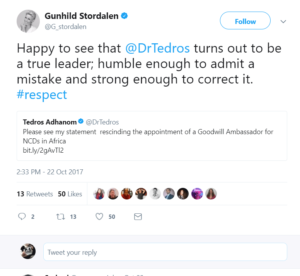
Gunhild Stordalen

Director-General of the World Health Organisation Tedros Ghebreyesus had been scorned for appointing Zimbabwe President Mugabe as goodwill ambassador.

With one tweet, Gunhild Stordalen made the point that it was Tedros’ own admittance of the mistake, that showed leadership.

Makes local story global

NCDfree makes short films that focus on particular NCD topics, like heart disease in Mongolia, health systems in Ghana, and community health in Melbourne. .

Last year they decided to take on the sugar taxation discussion by humanizing the public health issue of rising obesity and sugar based beverage consumption. Different governments’ attempts to reduce sugar intake and improve global health by implementing a soda tax have been labelled as a ‘sin tax’ by critics, media and the sugar lobby.

“If there are two things which people hate it is ‘sin’ and ‘taxation’. But we believe this is a serious public health issue and identified this as an opportunity to put a human face to the topic.”

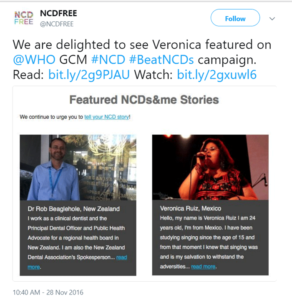
NCDfree posted a short film about Veronica, a young musician from Mexico City who explained how soda had affected her and her father’s health.

“We tried to change the narratives around this topic. We released it on YouTube and then posted it on Twitter, and the World Health Organisation Global Coordination Mechanism for NCDs saw the film. They were soon to be hosting a meeting on NCDs and wanted to highlight the voices of those living with NCDs.”

“There are millions of others like Veronica who have a story to tell, and we want to use our social movement to provide a much needed platform.”

“The result. Not only did the WHO want to show our short film at the meeting, but they wanted to invite Veronica to the conference to tell her story in person to the range of high level ministers and decision makers in the room.”
“Ultimately, when you have an individual telling their personal story about how they are affecting or affected by NCDs, then this is a very powerful communication tool. It has much more impact than hearing someone just talking about the burden and various statistics.”

“Giving people like Veronica a voice, through social media, will lead to more opportunities like at the WHO, and will lead to a sustained change. There are millions of others like Veronica who have a story to tell, and we want to use our social movement to provide a much needed platform.”

Sign up on ncdfree.org/campaign to get more information about how you can be part of a global solution using food, technology and our brains for some of our biggest alcohol-related health and social challenges.

Follow Jack Fisher on Twitter here.

Were you inspired by this? Do you have any other ideas how non-government organisation campaigns can connect  audiences through Twitter?  Feel free to leave any comments !

Does your organisation need to influence policy and publics? My Twitter course for professionals shows you how to target the people that count through social media lobbying!
Hvad virker bedst til konferencer: Facebook eller Twitter?

De to platforme, Twitter og Facebook, blev testet i en kampagne op til en stor europæisk konference for journalister. Danske læsere vil måske blive overrasket over resultatet

For de fleste privatpersoner er opslag på Facebook og Twitter gratis. Men mange virksomheder og organisationer vælger alligevel at betale sociale medier for at promovere deres indhold, så de når til et bredere publikum.

Twitter and Facebook campaign

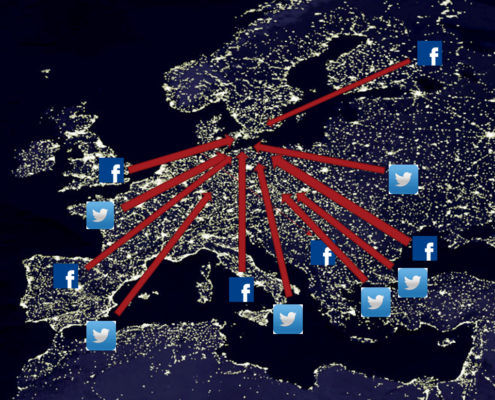
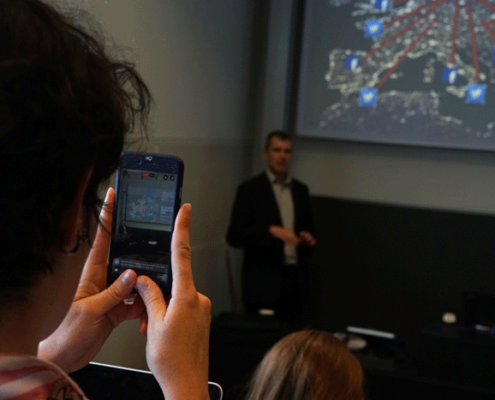
Jeg præsenterede de to kampagner, Twitter og Facebook, på selve ECSJ 2017 konferencen

Især hvis der er brug for at tiltrække mennesker til et bestemt event og hvis du har en kort deadline kan en betalt promovering være en rationel måde at gribe det an.

Men hvad er bedst? Twitter eller Facebook?

Jeg fik mulighed for at teste det i forbindelse med mit arbejde for den europæiske konference for videnskabsjournalister ECSJ 2017 i København i juni måned.

En af mine opgaver var at gøre europæiske journalister opmærksomme på konferencen. Med et lille reklamebudget kunne jeg booste det samme indhold, der promoverede konferencen, bade på Facebook og Twitter.

Det gjorde, at jeg kunne teste, med et afgrænset og klart defineret mål, hvor godt de to platforme rent faktisk præsterede i forhold til hinanden. Jeg kunne se hvor mange mennesker, der klikkede ind på det underliggende ECSJ2017 konferencesite fra henholdsvis Twitter og Facebook. Og jeg kunne bruge webstatistik fra Google Analytics til at vurdere sandsynligheden for, at mit publikum rent faktisk dukkede op til konferencen.

Se på hele Twitter- og Facebook-analysen med tallene og kommentarerne her.

Pærer og bananer

Først et par ansvarsfraskrivelser.

Præferencer omkring Facebook, Twitter, og andre sociale medieplatforme, er ofte bundet op i personlig smag og præferencer.

Twitter og Facebook virker meget forskelligt, og det er umuligt at målrette opslag på samme måde.

Men med dette forsøg, som handlede om at nå ud til flest – for et givet antal penge – på to forskellige platforme, prøvede jeg alligevel at finde noget interessant som andre kan bruge. Det giver måske en dybere indsigt i hvordan boostede opslag virker, og forhåbentlig kan det give inspiration til jeres egne kampagner!

Se på det som et casestudie i, hvordan man rent teknisk kan promovere konferencer. Datasettet kan måske, måske ikke, have relevans for andre faggrupper end journalister. Men tallene er da interessante!

Se hele analysen her.

Få mere gennemslagskraft på de sociale medier! Her er mit Twitterkursus for professionelle, forskere og eksperter.

Se mine andre serviceydelser her.

Which is best: Twitter or Facebook for promoting events?

Twitter or Facebook? The two platforms were tested on a campaign for the European Conference for Science Journalists. There was a clear winner

For most people in a non-professional capacity, posts on Facebook and Twitter are for free. But many businesses and organisations opt to pay the social media platforms to boost their content and posts so they reach a wider audience.

Twitter or Facebook

Campaign tested on both Facebook and Twitter

If you need to attract followers fast, make people aware of a specific event, or advertise, then promoting or boosting content can be a smart thing to do.

But which is best? Twitter or Facebook?

I got the opportunity to test this in connection with the European Conference for Science Journalists which took place in Copenhagen 26th-30th June 2017. Mike Young Academy took care of the outreach and social media for the conference.

One of my tasks was to make journalists in Europe aware of the conference. With a small budget for advertising I was therefore able to boost the same underlying content, promoting the conference on both Twitter and Facebook.

This allowed me to test, for a limited and clearly defined goal, the relative merits of the two social media platforms: I was able to see how many people clicked on to the underlying conference website ECSJ2017.com from each platform for each boosted campaign. And I could use web data measured via Google Analytics to estimate (via proxies like bounce rate etc.) the likelihood of the intended audience ultimately coming to the conference.

Three-step process

Finding out which platform performs the best is a three-step process, where I first compare the reach, then the engagement, then the quality of the traffic coming from each platform.

First the reach, or the number of people who see the content on their Twitter and Facebook news feeds:

I take the same underlying content, three different webpages on ECSJ2017.com (a survey, a travel grant and a registration deadline) and post it on Twitter and Facebook. I then use the same amount of money to boost or promote the content on each platform, trying to maximize the reach of the content, and targeting as specific as I can to science journalists in Europe.

Second step is comparing the engagement, or the number of clicks that each boost/promotion resulted in on the ECSJ2017.com website. I can measure this using Google Analytics.

Third step is estimating the quality of the engaged traffic, or the relative number of people who register for the conference as a result of clicking on the boost/promotion. For this I use a number of measures, but mostly rely on bounce rate. More on this later.

I can then evaluate which platform performs the best.

Reach – getting it out on to people’s feeds

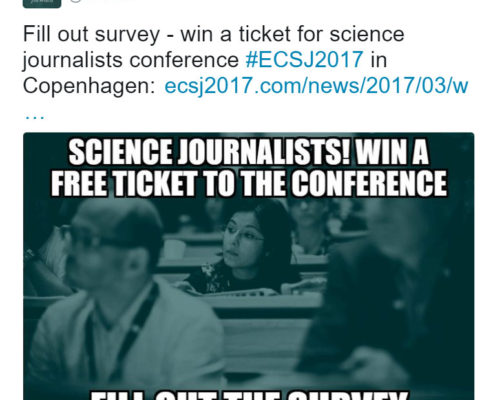
Here below is an example of one of the posts I boosted on the ECJ2017 Twitter account.

Twitter or Facebook

Tweet about a survey for #ECSJ2017 that was given a paid promotion.

I am trying to target the posts as specific as possible on science journalists in Europe.

Twitter offers a wide range of targeting options. I delimit the campaign to European countries and type in keywords like ‘science communication’ and ‘science journalism’. The idea is that Twitter matches your promotion with users’ profiles (and possibly the content of their tweets, Twitter does not say so).

Another interesting function is being able to match your promotion to people that you know on Twitter already. So I match the campaign to a few Twitter journalist profiles that already follow our profile and that have a good science journalism following already. The Twitter algorithm should then show my promotion to other profiles like them.

Balkans here we come

And it works!

Minutes after pressing ‘go’ on the promotion, the campaign is approved on Twitter and the traffic starts pouring in on the ECSJ2017 page, as can be seen on Google Analytics from all of the countries in Europe.

The targeting choices on Facebook are oriented towards consumer choices and lifestyle rather than interests.

After a couple of hours, I realized that we were mostly getting traffic from Southeastern Europe. This is fine, but I wanted to spread it out a bit, so I went in and edited out these countries from the promotion. The traffic then shifted to the rest of Europe.

What is happening here? My theory is that with the bidding system that Twitter uses, my tweet  is showing predominantly to Southeastern European locations as it can show them at a lower price.

But with the adjustments, it worked again throughout Europe. 66,000 impressions and nearly 2,900 clicks within a few days, according to Twitter’s own system. This squares roughly with the traffic that I can verify on Google Analytics. I paid around DKK 0.2 per click or EUR 0.03 per click.

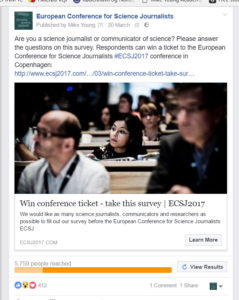
Now to Facebook. The Facebook post is below.

Twitter or Facebook

Post as used for the Facebook campaign for #ECSJ2017

The Facebook campaign has a harder time finding and targeting science journalists. The targeting choices on Facebook are oriented towards consumer choices and lifestyle rather than interests. But I set it up as good as I can, and pressed ‘go’. Strangely, and like Twitter, Facebook had a propensity to show my promoted content to Southeastern Europe.

The campaign garnered hundreds of likes, and even a few ‘heart’ emoticons. But few clicks. No matter what I tried, it appeared as if I ended up paying for ‘likes’ rather than clicks on to the webpage.

In the end it garnered 20 link clicks and more than a hundred page likes, and had me paying upwards of DKK 16 or EUR 2 per click, which seemed expensive.

Getting people to do stuff – engagement

“Are you a science journalist? Grants of up to EUR 600 for travel and accommodation in #ECSJ2017 in Copenhagen.”

This was the content of my second campaign, and by now I was learning the tricks.

Target the next Twitter campaign on countries, on keywords in profiles, and on users like the ones that follow you already. And be careful of the algorithm’s propensity to over-expose to Southeastern Europe.

It resulted in 76,000 impressions, got 3,400 clicks, at an average cost of DKK 0,20 or EUR 0,03 per click.

Facebook on the other hand, was still sluggish.

Facebook has a targeting function called ‘friends of friends’, and so I applied this. This means that the promoted post will be shown to anyone who is a friend of someone who already likes your page. The logic is, that if someone likes your page – say, a science journalist – then their friends are more likely to be science journalists.

To increase the pressure I subsequently promoted the same post using the so-called website tags function.

It was so much harder to reach people through Facebook, that the people we actually did reach were more likely to be interested in our conference.

Facebook, and Twitter, introduced website tags a few years ago. What it means is that you add a snippet of code to your website. Facebook and Twitter then target users in your promotions to people who are like the people who have visited your site already.

With this, more targeted, approach, Facebook started performing better. It reached more than 5,000 people, and got me 67 link clicks for a DKK 300 promotion, or around DKK 4.5 (EUR 0.6) per click.

But still, Twitter appears to be blasting away from Facebook.

Only people who are really interested, matter

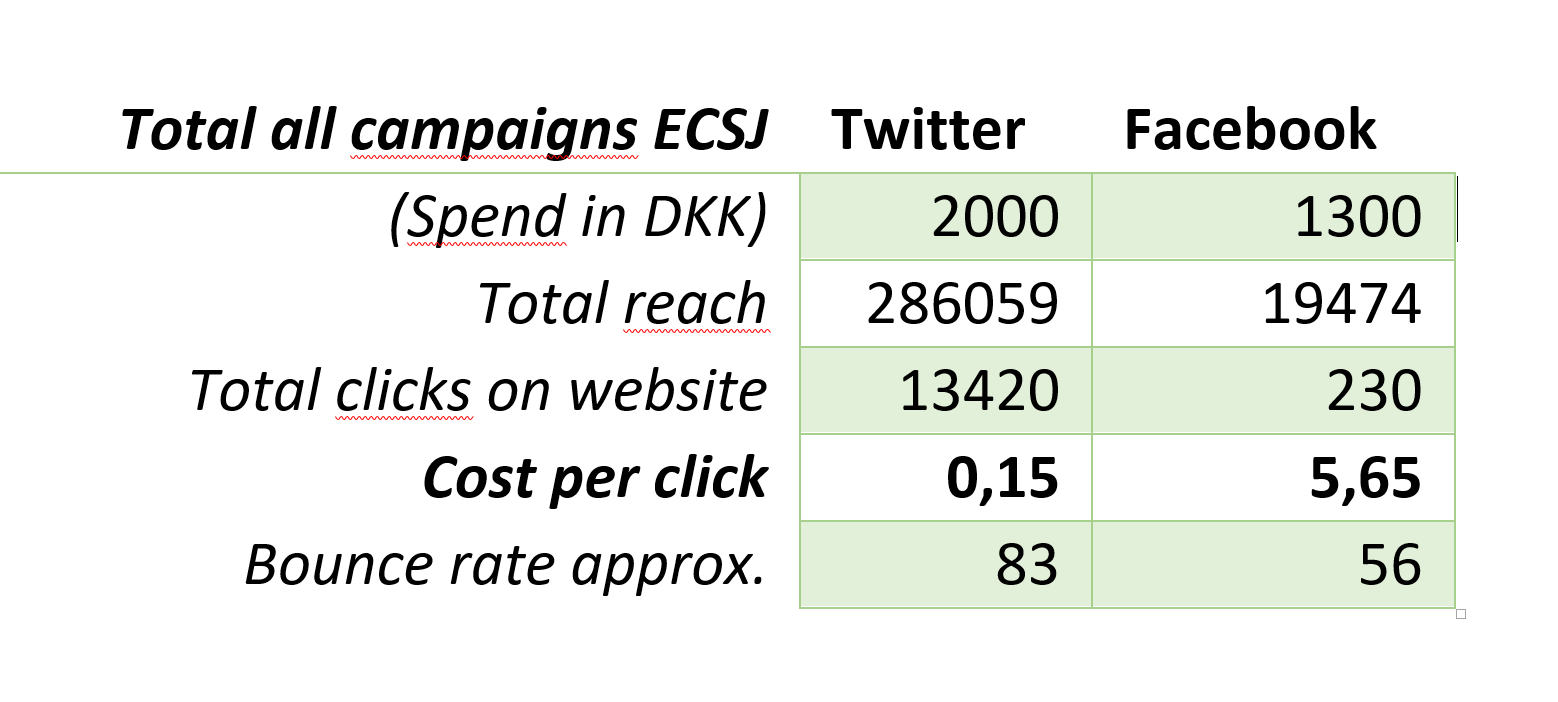
Here is a table showing an aggregate of the promoted posts with their reach or number of impressions, the number of clicks generated for each platform, the costs per click, and the bounce rate (more about bounce rate below).

Facebook vs. Twitter

Facebook vs Twitter for selected ECSJ campaigns

So we now know that Twitter is outperforming Facebook considerably. But what about the quality of the traffic generated? Is there more likelihood that the people coming through to your website from Facebook actually do something on your website, like register to the conference?

This is a hard question to answer, and could only be definitively answered if we had website tags set up throughout the conference registration process, so that I could follow users from Twitter/Facebook on to the ECSJ2017 site, then on to the separate registration site, and then exiting with a confirmed registration. This was not possible for us.

Difficult to verify

But there are other ways to measure the quality of incoming traffic. The ‘bounce rate’ is the percentage of people that enter your webpage and then exit without clicking on to another page on your site. The bounce rate can be used as a proxy for quality: People who are genuinely interested, and who come to your web page through a promotion will want to find out more by clicking on to other pages on your site. People who are not interested, or who have entered your web page by mistake, will leave right away.

The bounce rate for all the traffic coming in through our Twitter campaigns was in the range of 80 per cent. That means that 80 per cent of all the users who entered the page left again without clicking further on the site. Facebook did better here.  The low traffic numbers on Facebook meant that there is room for statistical error, but Facebook traffic had bounce rates ranging from 39-60 per cent.

On balance, the quality of the Facebook campaign traffic that I did get was better. My interpretation is that it was so much harder to reach people through Facebook, that the people we actually did reach were more likely to be interested in our conference.

By now you will realise which platform has won this contest overall though. Twitter outreached and then out-clicked Facebook by factors of up to 100. Even if you correct for a lower bounce rate on Facebook showing higher quality, Twitter gave us far more value for money.

On top of this, the promotion process on Facebook is complicated: It is hard to work out exactly how many paid clicks you have received for each paid promotion, and it can take ages (in one case, 22 hours) to get your promotion approved by the Facebook moderators.

Pears and bananas

Now the disclaimers. Comparing Facebook and Twitter is, of course, like comparing pears and bananas.

First, Twitter and Facebook work differently and it is impossible to target users on the platforms in the same way. But my contention is, that if I maxed out on my own attempt to target the audience on each platform, to the best of my ability, I would at least prove something.

Second, the likelihood that Twitter will win this contest is greatly increased by the fact that Twitter is the social media of choice for journalists.

So look at this as a case study in the promotion of content up to a conference event.

The data may, or may not, have relevance for other fields. But even I was surprised to see the numbers!

Should I have promoted the content differently on each platform? Are there better ways to measure the quality of the traffic? Have I made a big mistake? Please let me know! I am interested to hear any comments you may have!

Be a social media influencer! Here is my Twitter course for communicators, researchers and experts. See Mike Young Academy services here.