For scholars, being kind could be contagious
A new paper argues that small, voluntary acts of kindness can ripple through communities, improving mental health. What might this mean for scholars on social media?
It is a good idea for governments to promote voluntary acts of kindness. And it is a good idea to practice being kind yourself, according to a paper by Tri-Long Nguyen and Ji Young Lee, both of the University of Copenhagen.
Practicing kindness can improve mental health and well-being in both individuals and at a societal level. In their paper Kindness as a public health action, they argue that policies that encourage voluntary acts of kindness are practical, cost-effective, and ethically sound.
Their paper was recommended to me recently while I was interviewing sources for our forthcoming book on ‘Social Media for Research Impact’. So I thought, could this be applied to the idea of being a kind academic on social media?

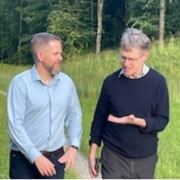
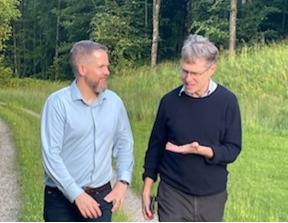
Tri-Long Nguyen (left): In the Buddhist tradition being kind to yourself is not in opposition to being kind to others.
Tri-Long Nguyen is an associate professor in epidemiology with a background in pharmacy, statistics, and education. When he is not doing science, he reads a lot about philosophy and Eastern practices like Zen Buddhism. His work with Ji Young Lee, an assistant professor in philosophy and bioethics, makes the case that being kind is not only a nice thing to do: It is evidence-based good practice.
Algorithm as a kind actor
In their paper they used the preventive medicine framework proposed by Geoffrey Rose in work from the 1980s. He is known for the ‘prevention paradox’: Massively applying to the general population an intervention with small individual benefits is more effective than targeting only those at high-risk of disease. This is because the number of people at high risk is small, so targeting only them would prevent a lower number of absolute cases.
“The biggest mental barrier that people have is the fear that they cannot change the world alone from an individual position”
Just like infectious disease, acts of kindness cascade and multiply, Tri-Long Nguyen and Ji Young Lee argue. And just as in preventing disease, the small individual benefits of cultivating kindness, understanding, love and compassion can collectively generate large-scale social impact by propagating positive effects beyond the initial recipient of the kind actions.
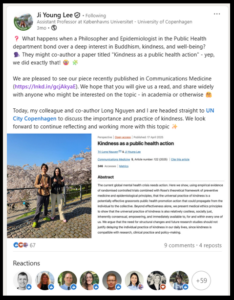
Co-author Ji Young Lee posted about their paper on LinkedIn
In a blog post recently I listed 11 kind habits academics should get into on social media. One of my pet theories is that by doing specific kind practices on social media you are shaping a community around yourself so there is a higher chance of these kind of interactions taking place in the future in your social media vicinity.
This is not just the effect of people copying you. It is because platforms’ algorithms tend to surround you with people who are doing the same types of kind actions, this reinforces the practices as a collective action due to network effects. You are basically creating ripples of kindness, and the algorithms may be reinforcing it. So by practicing kind actions on the social media where scholars are active, you are helping the whole of academia become a kinder place.
Collective conciousness
Our paper “is exactly analogous to this,” Tri-Long Nguyen said when I presented my own pet theory to him on our Zoom call.
“The biggest mental barrier that people have is the fear that they cannot change the world alone from an individual position. But I think that when we change ourself we inspire other people to change themselves as well. We’re not on separate islands and that’s what we try to emphasize in the paper.”
I put it to Tri-Long Nguyen that support for the contagiousness of kindness theory can be found on the Reddit platform. People post here anonymously, on different subreddits, each with a different topic. On many of them, people respond voluntarily to help other people, with no other reward than the knowledge that they are helping others. As they are posting anonymously, there is no reason to believe they are doing it for egoistical reasons or to boost their status. By responding, they are simply helping their community and at the same time increasing the likelihood that other people do the same.
“The non-action is what we cultivate before we speak, before we write, before we perform an act of kindness”
For Tri-Long Nguyen this type of social media practice, and their own paper, ties in well with his practice of Zen Buddhism. If ‘being kind’ propagates to others, it is a sociological phenomenon that can be analyzed through the lens of ‘complexity theory’ and ‘system theory’. But the Buddhist tradition has, through the course of millennia, had a lot to say about it also. For example how being kind to yourself is not in opposition to being kind to others. We are all, in this tradition, ultimately nourishing and cultivating a same ‘collective consciousness’ that we all ‘consume’. There is no separation between you and me, we are interconnected.
Non-action
I showed Tri-Long Nguyen two slides from a recent social media workshop I did for researchers: The first slide outlines a ‘mindful’ approach to social media platforms that protects your attention span, guards your boundaries, and avoids the constant pressure to perform. The focus is on self-care. The second slide outlines an ‘ethical’ approach to the social media platforms that encourages generosity, openness, and support for others. The focus here is on social media as a channel to fulfil our ethical obligations.
I knew, even before I asked him, that Tri-Long Nguyen would politely dismantle my distinction. Are they basically the same thing?
“Yes they are!” Tri-Long Nguyen responded.
“We cite at the very end of our paper the Zen master Thích Nhất Hạnh. He talked a lot about how when we talk about action, we often think about something concrete, like something to do, write, say, or do physically. But there is another aspect that is non-action. The non-action is what we cultivate before we speak, before we write, and before we perform an act of kindness,” Tri-Long Nguyen said.
“Non-action is in a way already action because it increases our well-being and therefore shapes the way that we cultivate loving speech or loving actions to others. So that’s how I relate the two approaches, mindful and ethical.”
Social media for research impact is a new book by Mike Young and Marcel Bogers (forthcoming). It invites you to think more clearly — and ethically — about how to use social media. Not just to disseminate your research, but to connect, ideate, co-create, and stay open to the unexpected. The book page is here.